
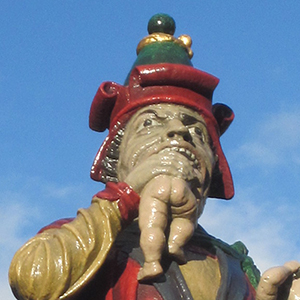
The ‘Kindlifresser’ or Little Child Eater fountain in Berne is a real attention-getter. Really, how often do you see statues of ogres eating children?
Berne has more than 100 fountains, 11 of which are sculpted allegorical figures made almost 500 years ago.In the Middle Ages fountains were usually located in the center of the street. They were the heart of city life and a source of public water. People gathered around them to gossip or wash their clothes. There were even fountain guards who acted like bouncers. They made sure people only took their allowed 5 liters of free drinking water per day.
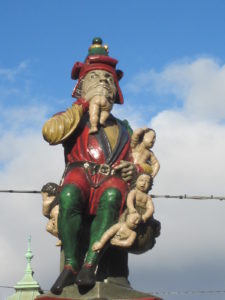 The Child Eater fountain was built in 1545/46 by the Renaissance sculptor Hans Gieng. It was originally just called the ‘Plaza Fountain’. It’s of an ogre dressed in a red and ocher top and green tights wearing a somewhat pointed red and green hat. He is sitting, greedily eating a naked child with seven more squirming children in a bag and to his side.
Interpretation
The city of Berne commissioned the sculpture, so that means Gieng wasn’t completely free in what to sculpt. As far as I know, there is no documentation for the commission. That leaves a lot of room for interpretation.
So, what in the world is the city of Berne trying to tell their citizens? Little children are best when eaten while sitting? Only eat one child at a time? Don’t talk with your mouth full? It’s hard to say. Hans Gieng died in 1562. So we can no longer ask him exactly what the intent was.
I guess we’ll have to leave that to the scholars and there, opinions differ.
Anti-Jewish
One of the most popular interpretation is due to the hat the ogre is wearing. Some believe the pointed hat is Jewish. In the late Middle Ages Jews were resented because of their cultural differences and economic successes. The attitude of Christian Europe towards the Jews during this time was anything but amicable. For that reason, quite often the fountain is attributed with anti-Semitic meaning. Many associate child eating with the blood libel and the blood of Christian children. This could be interpreted as: beware of Jews.
Saturn
Others postulate that the ogre is the Roman god Saturn eating the months. But for me the numbers don’t add up. Depending on the calendar there are either 10 or 12 months. There are only 8 children in the sculpture. Maybe this could be interpreted as: time is running out.
Cronus
Some believe it is the Greek god Cronus eating his children. Greek mythology isn’t my strength, but didn’t Cronus ‘only’ eat 5 of his children? Again, the numbers don’t add up. Still, the reason he ate them was because he heard a prophecy that they would take over his rule. With that, he decided to get rid of them before they could get rid of him. I guess the interpretation here would be: get your opponents before they get you.
Cardinal Schiner
Another alternative and pretty wild theory is that it depicts the military commander Cardinal Schiner. He led the Swiss Confederation into several bloody defeats in northern Italy some 30 years earlier. A Cardinal and eating children? That interpretation? I don’t even want to go there.
Krampus
Others speculate that the ogre depicts Krampus. Krampus, a ‘half-goat, half-demon’, punishes bad behaving children during the Christmas season. I suppose his alter ego would be Saint Nicholas, who rewards well-behaved children with gifts. Similar to ‘bad cop’, ‘good cop’.
In Switzerland, on December 6th, ‘Schmutzli’ [little dirty] is St. Nicholas’ companion when visiting children. Although today he is by no means a dark, dark figure maybe he is the ‘modern’ Krampus. That the child eater could be Krampus or Schmutzli is based on the 16th century preconception of what to do with bad children. Everyone knew that the devil ate the souls of unbelieving children after kidnapping them, whipping them and cutting their throats. Now that’s a pretty nasty punishment.
Hansel and Gretel
Talking about eating children reminds me of the German fairy tale of Hansel and Gretel. Recorded by the Brothers Grimm and published in 1812. The tale originates from the Great Famine (1315 – 1321). That caused desperate people to abandon young children to fend for themselves or even resort to cannibalism. Grim, Grimm. At least we can be fairly sure the fountain has nothing to do with this fairy tale.
My Interpretation
Fountains were the center of urban life at that time and the population was relatively uneducated to be sure. In the 16th century many fountain sculptures presented a clearly symbolic and moralizing character. These two facts make me believe that there is probably no deeper meaning at all. It was most likely just intended to frighten disobedient children. ‘Be good or the ogre will eat you like those other bad children!’
Today fountains are still an important part of Berne. One of the newer fountains built in 2004 is in front of the Federal building. There, a series of jets of water, which represent the cantons, spring up through the pavement at different intervals. Children love playing in it in the summer. I wonder how people are going to interpret that 500 years from now.
The nice part about the Child Eater fountain is no one knows for sure what it’s supposed to represent. In that case, it’s open for interpretation and can stand for whatever you want. Take your pick or make up your own interpretation.
 -
- -
-