
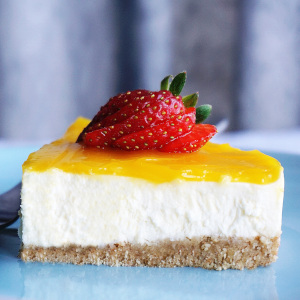
Okay, everyone knows what a cheesecake is, right? Maybe. Well, it depends on where you are and what language you are speaking.
Friends for Dinner
We invited friends over for dinner. My friend said she would bring a cheesecake so I didn’t have so much to do.
They came and we ate outside. We had grilled pork chops, potato salad and stuff like that. It was a nice dinner. After we were finished, I said “Okay, time for the cheesecake!” At a loss for words my friend and her husband looked at each other in disbelief. I thought “Oh my, I misunderstood and they hadn’t offer to bring cheesecake at all. Maybe they had brought something else, and here I was talking about ‘cheesecake’.” An embarrassing faux pas.
Finally she said, “I meant ‘Käsekuchen’”. ‘Käsekuchen’ translates directly into ‘Cheesecake’ but they are two completely different things. I don’t remember if we were speaking German or English when she offered to bring a cheesecake. At the time I just automatically assumed it was dessert. After all, we had invited them to dinner at our home. Quite often people bring dessert but no one had ever offered to bring a main course before.
I asked why she hadn’t said anything when they came. She said that she saw I had already made the preparations for the meal. She thought that perhaps I hadn’t heard her when she said she would bring the cheesecake. It’s amazing how self-doubt can creep in, too. She thought it was possible that she hadn’t even told me she would bring something. Whatever the reason, it was obvious that two main courses was one too many. So why mention it?
Well, that was certainly an experience. With some quick thinking and a bit of luck we dug up something for dessert. The evening was saved.
Cheesecake or Käsekuchen
But how could it come to such a mistake in the first place? What is a ‘cake’? Well, if you are not talking verb, then it’s a food. It can be either sweet or savory, savory being salty or spicy. If you say ‘cake’ in English more times than not means you are talking sweet. ‘Kuchen’ in Swiss German can be either. Sometimes the dialect can help. In Basel German, for example, the word for ‘flat and round’ is ‘Wähen’ [‘vy’ is pronounced similar to ‘my’. The whole word is pronounced ‘vy-ya’]. The term ‘Käsekuchen’ in Bernese, is ‘Käsewähen’ in Basel German. There is no mistake what is meant there, flat and round, nothing cake about it. But we are in the Canton of Berne and the Basel word ‘Wähen’ doesn’t exist in Bernese. That’s just the way it is.
It seems savory ‘Käsekuchen’ is very Swiss. Of course it is, Switzerland is the country of cheese. The Swiss variety ‘Käsekuchen’ is a mix of Greyerz cheese, Swiss cheese (Emmentaler), milk and eggs in a salty pie crust. Yummy and filling when eaten warm.
A cheesecake in English is a sweet custard tart. It is made of cream cheese or ricotta along with eggs and sugar. The cheesecakes I know usually have a graham cracker crust. It may be baked or unbaked. Quite often it is topped with berries or fruit and may or may not have whipped cream on top.
Cheesecakes in Europe
Still, I’m not the only one who gets ‘Cheesecake’ wrong. Some friends told us something that happened when they were in a bakery-café in Switzerland. Germans came in and ordered some ‘Käsekuchen’. They were expecting something sweet so they asked if there were cherries or raspberries on top. The waitress, somewhat bewildered said, no, but they could have bacon with it, if they wanted.
The Germans were surprised to say the least. Imagine ordering something sweet and being offered bacon with it! Okay, for the sake of argument, it can be done. Think pancakes with syrup and bacon. Sorry, I am rambling somewhat. Then the waitress realized what the problem was and cleared up the confusion. The bakery didn’t serve sweet cheesecakes but savory ‘Käsekuchen’. The Germans, who came in for something sweet, decided to go out on a limb and try something different. They ordered the Swiss Käsekuchen (without bacon) and they were pleasantly surprised.
There’s got to be a moral hidden somewhere in the cheesecake stories. Possibly to make sure you know exactly which course your guests offer to bring to dinner. Or possibly just asking the right questions can stop a surprise in its tracks. And, always have a quick, optional dessert on hand. Just in case.
 -
- -
-