

Here it is, the third part of my three steps in understanding the context of any 17th or 18th century text, or any text for that matter. Step one: you have know what letters in which alphabet you are looking at. Then step two: you can form the words. The third and last step is understanding their context through the sentence structure. Again, not quite as easy as it sounds.
Step 3: Pulling it all Together for Meaning

Knowing the letters and spelling conventions or lack thereof you can figure out the letters of a word and still not know what word you are looking at. Assuming that the writer spelled it ‘correctly’ or close enough, time to pull out a dictionary.
English Dictionaries
The first monolingual dictionary ever published was English and written by Robert Cawdrey in 1604. He arranged the approximately 3000 words alphabetically and included a brief description. It was an attempt to explain the ‘hard words’. The first ‘modern’ dictionary that included regular, everyday words, not just the hard ones, also made an attempt to standardize the spelling and grammar. Samuel Johnson wrote and published it in 1775 some 150+ years after the Cawdrey dictionary. It took 7 years to complete and encompassed 42,773 entries including 114,000 literary examples.
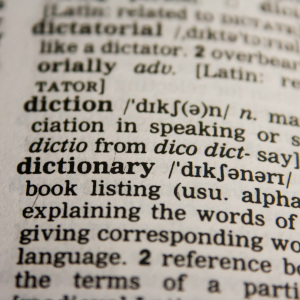
I needed a dictionary to understand the Scottish church minutes, because frankly, there were a staggering number of words where I had only a general idea of what they meant. I was glad that I found a 20th century dictionary online that contained definitions of most the words I was clueless about. It helped me understand better what the clerks were writing about. For example if the writer wanted an antonym for a word, he would just throw in an ‘un’ at the beginning of it. They wrote about breaking up the clan system using the word ‘unclan’. Another example was the word ‘compear’. I was able to figure out from the context that it meant ‘to appear’, but the word ‘appear’ appeared in the texts, too. My dictionary solved that problem, too. It is Latin and in Scottish law it means to appear in court personally or by attorney.
Latin Dictionaries
Speaking of Latin. To add a little bit more spice to our lives, the clerks sprinkle Latin phrases in ad nauseam. If I didn’t recognize a word and couldn’t find it in my online dictionary, I figured it was probably Latin or an abbreviation thereof. Unfortunately my Latin knowledge didn’t take me far. Vitiis nemo sine nascitur (No one is born without faults. – Horace). So I had to find an online Latin dictionary, which more times than not pointed me in the right direction.

It was interesting to even look up words that I knew because sometimes the meanings differed slightly to what I thought they meant. For example I thought a ‘lass’ was just a young girl. That is partly correct, in Scotland it also means a woman-servant. That fit the entry perfectly because they were writing about a ‘lasses master’.
So, with the help of my dictionaries I understood most of the words. I was moving quickly towards my goal of understanding the text.
Punctuation
Once you have the words and their meanings it’s time to read the sentences. That’s a good plan, but rather difficult to implement because punctuation was practically nonexistent. It seems that no one at that time thought the period and comma as a necessity as far as I can tell. Everyone loved run-on sentences and no one loved commas so that left you to your own devises to figure out what the scribe meant. You know, the ‘Let’s eat Grandma’ kind of thing. Often times the writer actually did introduce tell a new thought with a new line. But that was about it.
The little punctuation that they did use differed slightly from their usage nowadays. The colon was not used to introduce a list (that was done with the Latin word ‘viz’) but to indicate an abbreviation. The slash ‘/’, known as the virgule, was used in the same way as we would use a parenthesis. Parentheses weren’t used at all. Apostrophes were used or not, depending on the mood of the clerk. Was that ‘s’ on the end of a word a possessive, plural or contraction? Again, the reader had to figure it out for themselves. Generally speaking punctuation was avoided like the plague.
Wrapping it up

So in the end, understanding a text is built on three easy steps. First learn what the letters look like in the alphabet used in the text that you are trying to transcribe. Then figure out the words, taking in account the spellings and abbreviations. After that, top everything off with a bit of flashy creativity in making sentences along with the help of a good dictionary. Creativity is the correct word. Sometimes you have to read a ‘sentence’ many different ways until you end up with a sentence that makes sense. But it’s worth it, or at least Grandma thinks so. So ‘let’s eat, Grandma!’
I hope you enjoyed this excursion into the wild world of reading and understanding 17th and 18th century texts. The steps pertain to other languages, like German, too. Who knows, the next time you run into an old text you just might be able to understand it.
This is a snippet of a letter that William Scott wrote in 1646 to the Earl of Buccleuch.
It’s about a case of Simon Armstrong;
‘God knows I lowe none off thesse roges bott I am ernestlie intreittit to speike for his leberttie be ane Ingliche gentellman quhom I have recewed sewerall kyndesse off’.
I creatively translated that into; ‘God knows I know none of these rogues 1, but I am earnestly interested to speak for his liberty being an English gentleman, whom I have received several kindness of.’
So, wrapping it up I can only say, qt is realli inter: about transcribing aside frome the fackte yt you learn a lot aboute yore Ansestores per se is I realizd if you reed Something yt was writ wrong enough times it lookd korrekt.
1 Obviously William Scott doesn’t have a high opinion of Simon Armstrong.
 -
- -
-