Some days the weather does strange things and doesn’t play by the rules. One day, a couple of months ago when I got up and looked outside, it was foggy. So? That can happen, like in the Fall. But wait, it was the end of March, that’s supposed to be Spring. Strange. Weird things were happening weather-wise even Ben noticed it. While talking to his sister on the phone he said something about the similarities to “1816, the summer that wasn’t”. What was he talking about? Of course I did what anyone else would do, I Googled it.
The Summer of 1816
In 1816 it seems it wasn’t just a couple days of foul or cool weather. I found out that it was a worldwide phenomenon. In the northern hemisphere, severe frosts occurred every month, there was snow and ice when there shouldn’t have been. In northern Europe abnormal and cool temperatures and heavy rains prevailed. This cut the production of crops dramatically and produced the worst famine of the century. On the heels of famine came disease. It wasn’t only a year without a summer but a downright nasty year.
As if famine, disease and cold wasn’t enough. No, Mother Nature did her best to make it a memorable year everywhere including Switzerland. The Giétro Glacier, located in the canton of Valais, formed an ice cone. The cone trapped water like a plug and formed a lake. The level of this new lake rose and rose putting pressure on the cone. An engineer named Ignaz Venetz tried to circumvent a catastrophe by drilling a tunnel to divert the water. Still, Mother Nature won, it broke. The lake emptied within a half hour and flooded the valley, including Martigny taking 44 lives with it.
Volcanic Eruptions
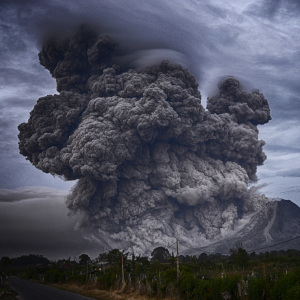
Was this just a bad set of circumstances? A whim of nature? Hardly. It took scientists nearly 100 years to figure out what exactly had happened. It was Mother Nature’s coup. She pushed the first domino piece and the rest toppled accordingly. A volcano, Mount Tambora on the island of Sumbowa in Indonesia erupted. It wasn’t “just” and eruption, it was the biggest in almost 2000 years.
It threw up massive amounts of dust and ash which dissipated into the atmosphere and blocked the sun. Everything’s connected, so one disaster led to another and then another.
Just so you can get an idea of how powerful this eruption was there is an intensity scale called VEI (Volcanic Explosivity Index). It goes from 0 to 8 and has to do with ejection volume. Mount St. Helens and Vesuvius eruptions were both classified as a 5 meaning their stratospheric injection was significant. The 1815 Tambora eruption was classified as a 7 and its stratospheric injection was substantial. The VEI 7 before that was in 1257, so they don’t happen very often. The only eruptions that are larger are 8s and then we are talking about Yellowstone and Taupo.
Silver Lining
As always there has to be a silver lining. Looking at art, for example, William Turner (J M W Turner) was a master at painting color, light and skies. Between 1816 and 1818 he painted his impressions in his sketchbook titled “Skies”. Thanks to the volcano eruption there is no doubt that there was dust and particles in the atmosphere. The sun that managed to reach the earth through the particles created vibrant sky colors. Turner was able to capture the dramatic sunsets to perfection. Have a look at it.
The aftermath of the eruption also gave us some interesting reading. During the summer of 1816 Mary Shelley, then 18 and some friends were visiting Lord Byron at the Villa Diodati. It is a beautiful villa on the lake of Geneva in Switzerland. Due to the bad weather however they were forced to stay inside a lot. They occupied their time by reading ghost stories and then decided to each write a short ghost story. Mary Shelley’s short story turned into a full-fledged novel; Frankenstein; or, The Modern Prometheus. I guess the weather created a dark mood, perfect for monster stories. If you wish to read the book, the copyright has expired and you can download it at the Gutenberg Project for free.
Although there have been many volcanic eruptions this year, none have been similar in size to the one in 1815. So I guess our Spring/Fall day was just a quirk of nature.
 -
- -
-