
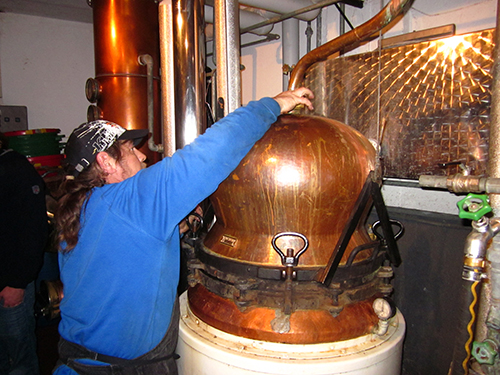
After moving to Lengnau, Ben and I joined the local business association. One of the first events we got an invitation to was for a ‘Treberwurst’ dinner. I had heard of and tasted a lot of different kinds of sausages but ‘treber’ wasn’t one of them. My Swiss husband Ben had never heard of it before either, so I expected the worst.In the invitation it was written up as a ‘traditional Lake of Biel sausage’. Because the Lake of Biel is known for its perch I envisioned some kind of weird fish sausage. Still, in spite of my misgivings we went anyway. What’s the worst that could happen? That it would be horrible, inedible and we would have to stop at another restaurant on the way home.
Treberwurst
There is really no coincidence that ‘Treberwurst’ is from this region but it has nothing to do with fish. ‘Treber’ means ‘marc’ and this region is smack full of vineyards. Ah ha, we’re talking about some kind of an alcohol sausage here.
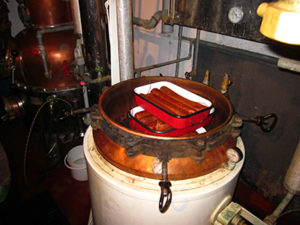 Traditionally a marc sausage is a raw smoked pork sausage from either Vaud or Newcastle. It is steamed at 78°C with alcohol vapor during the process of making pomace brandy. Pomace brandy is called ‘marc’ in both English and French and ‘grappa’ in Italian. Unlike wine brandy, pomace brandy is made by distilling pressed, fermented grapes, sort of the leftovers from making wine. Putting the sausages in the vat for about one hour cooks them and gives them their special aroma.
History
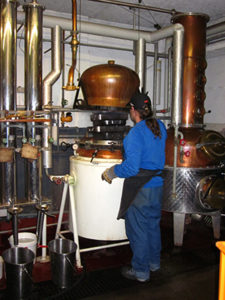 Way back when, winemakers distilled their brandy in front of their own cellars in the open air. I think traditionally pigs were butchered in the Fall, so regional pork sausages was probably what the workers ate. Why not use the secondhand heat to make a warm meal? This was almost certainly what the smart vineyard workers did between Biel and Newcastle. More than likely while sampling their fresh brandy.
Realizing that they were onto something good. Sometime during the begin of the 20th century the winegrowers started serving the marc sausages to friends and guests.
After a while the tradition almost faded away until the late 1970’s. Then one businessman winemaker in Twann ‘rediscovered’ the idea and it took off. The sausage was so good and was perfect for filling for the lull in the wine season. So they expanded the idea and made it more profitable. Why not sell some of the new wines and marc along with the sausage? It soon became an important part of their income. To achieve even more of an ambiance, it is often served in the vineyard’s vaulted wine cellar.
The Meal
The marc sausage is prepared only hours before it is eaten. Like I mentioned before, they are made while distilling pomace brandy. Distilling is only done between January and March. Hence, that is the only time you can get this specialty. It has become so popular you have to make reservations to assure a table and meal.
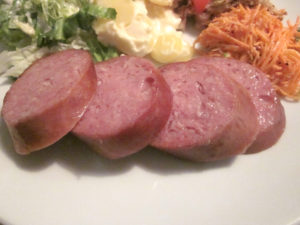 It is usually served with potato salad or gratin, leek, lentil stew or bread. Of course you drink the local wine or marc with it. Often it is flambéed in marc. And what does it taste like? Not what you might expect and certainly not like eating solid schnapps. In fact, only after it is cut and has time to soak up some of the juice does it even have a hint of brandy-taste.
My opinion is, it’s very good and well worth the trip to the region. You might, however, want to take public transportation to get there and back home. Just to be on the safe side after all, the local wines and marc are pretty darn good, too.
 -
- -
-