
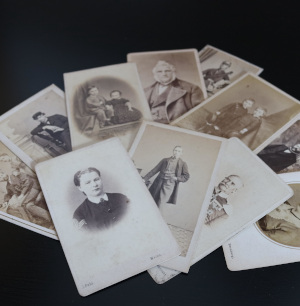

When doing genealogy usually all you have to work with are old documents. Being able to read the original document is a big plus. It somehow puts you closer to being there. Having to rely on what someone else has transcribed can leave you asking yourself if they got it all correct or did they leave anything out? Of course it’s better than nothing but certainly not as good as the real deal. But in the end you have to go with what you can get.
The fact that Ben and I started our ancestor search on his side of the family meant that we were reading German from the start. And, because we began our search so many years ago that also meant we were travelling from church to church. We were looking at the original documents and not sitting at home in front of the computer. In fact, there were no computers at that time to sit behind. I’m only kidding, there were computers. Still you didn’t have the comfortable situation you do today where you have databanks that spit out more information that you have the capacity to deal with. But at that time we were more or less church hopping and dealing with real people and not computers.
Finding the Books
Church hopping alone won’t necessarily get you together with the information you are looking for. But it wouldn’t be challenging if there weren’t a few obstacles between you and your goal. Luckily obstacles are a common commodity.
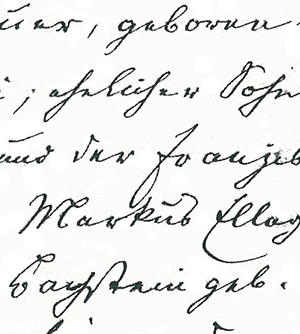
Being neophyte genealogists we didn’t really know back then what we were doing. But it looks like we were fortunate enough to make some right moves that got us going in the right direction. For starters we had to know which church books we hoped to find information in. So to that end we had to get to the right church. We found that most church offices are only open one half day a week so we had to plan to be there on the right day.
Then once we were standing in the right place at the right time, all we had to do was to tell whoever was working, which years, who and what we were looking for. They then dutifully disappeared into the dark corners of the church archives and returned with one or possibly more books. We had finally arrived at our goal. No more obstacles between us and the information in the church books. So with the book in our hands we hit the ground running.
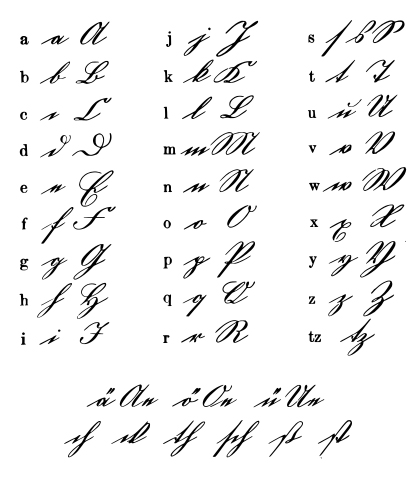
But we didn’t get very far into our search before we had to slow down to a brisk walk and then down to the speed of window shopping. What was going on? This was in German which we knew how to read but something was off, we couldn’t read the writing. All of the sudden we were mixing up the name Bonauer with Brunner. The fact was, our documents were written in the German cursive script which was used widely in the 19th century. As we were to find out quickly this was a weird script.
The German Cursive Script in Action
It’s a lovely handwriting but in the beginning I felt I was having to break a secret code to read it. Actually I’ve had that feeling a couple of times since we began. Speaking of secret codes and the German cursive script, a friend of ours found the perfect way to keep his grade school students from reading things he didn’t want them to read. After finding some old school protocols in the school attic that were written in the German cursive script he taught himself to read and write it. He was then free to leave his weekly curriculum plans and journals out in the open and still enjoy complete privacy. It really is that different to the untrained eye.
Before Ben and I continued on our genealogical search for his ancestors, we too learned to read it. Soon we were back on track and running.
Everyone Has Their Own Style
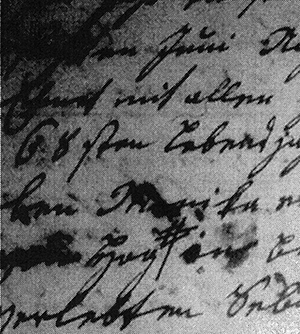
In a perfect world that would be the end of the story, but it’s not a perfect world. So it stands to reason that handwriting styles differ to fit the person. Next to the near ideal writing we often saw, we were also confronted with the dripping pens, blots, smeared ink and scribbling that barely passed for writing. The only things missing were the grease stains and spilled coffee. Obviously legibility was not high on the vicar’s priority list.
I assume that they didn’t have a writing class in school as they used to here in Switzerland (they don’t anymore). That’s where they practiced writing cursive so it was decipherable. It was so important that it was an individual subject in school like German and math and you got a grade in ‘pretty writing’ on your report card. But to give the vicars the benefit of the doubt, the ballpoint pen which made writing a lot easier, wasn’t invented until 1888. It didn’t really take off until the 1930s. Or if the pen wasn’t the cause of the messy writing maybe his mind was just so nimble that it moved faster than his hand. There you go, excuses for every occasion.
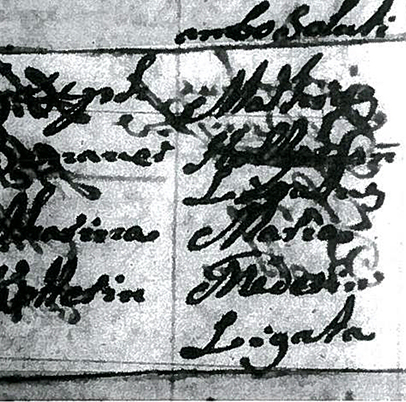
The further back we were able to research the more we saw the handwriting change back to what I would call normal. We ended up trudging through all kinds of handwriting. Sometimes we had to decipher letter for letter and then look to see if we had formed a word. We learned all the tricks and in the end no matter what writing style was used we more often than not figured out what had been written.
There is only one thing that has really stayed constant with writing throughout time. That you can always count on at least one or more vicars ending up with their books being incredibly illegible even if it wasn’t 100% their fault. But isn’t variety the spice of life?
 -
- -
-