
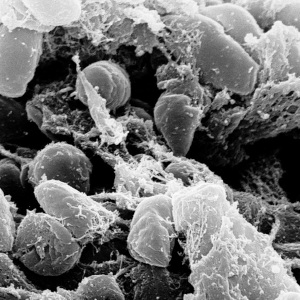
I can name direct ancestors of mine back to 1600, a long time ago. But now we’re going to step back a bit farther; 1348 – 1350, Switzerland and the Black Death. That was admittedly a long time ago but still, everyone has probably heard of the Black Death or simply ‘the plague’.
Correction (3 Sep 2026): The first sentence originally read “I can name direct descendants of mine back to 1600…” That makes no sense at all! It should read “I can name direct ancestors of mine back to 1600…” Thanks to an alert reader for catching that!
Setting the Scene 1291
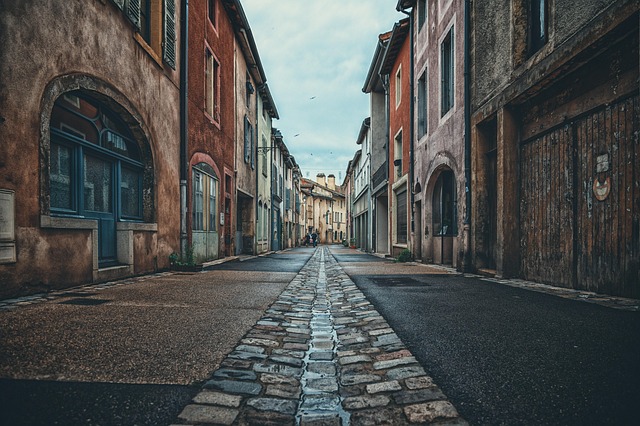
Think Late Middle Ages. Life was physically difficult, not particularly long and revolved around work, church and local community. The normal Joe was not literate. Clergymen, council members, merchants and the wealthy were about the only people who could read Latin or German well. Learning for all others was achieved through images, sermons and oral teaching.
Switzerland was not yet Switzerland. In 1348 there were the original three founding alliances plus one: Uri, Schwyz, Unterwalden all in 1291 and Lucerne in 1332. Zurich, Glarus, Zug and Berne were all waiting in the starting-boxes. But as so often the case is, life happens. The Black Death.
The Plague
Plague means to cause worry, pain or difficulty, and it did. To put it bluntly, the plague was terrible. It was certainly terrible to have to watch people die of it and even worse to die of it. It found its way into Switzerland seeping through the Italian speaking part of Switzerland first. The people at the time didn’t know how or why they got it. Although we now know fleas and rodents were the transmitters. It affected the cities the worst: Berne, Zurich, Basel and St. Gallen.
Once you caught it horrifying things happened to you within 3 to 8 days. First came the fever, with headaches, vomiting and weakness. Then glands swelled painfully and finger tissue, toe tissue or nose tissue turned black. Hence the name Black Death.
The chances of surviving this was minimal. Before the plague Switzerland had an estimated population of about 1 to 1.5 million people. We don’t know exactly how many people died, but an estimation is between 1/3 and 1/2 the population didn’t make it.
Plague Anxiety
Like I already mentioned, the people at that time were clueless as to why this was happening. They tried to piece it together with their limited knowledge. Basel was particularly hard hit and noticed that the Jewish population was barely hit by it. Voilà, they found a culprit! The majority of the people were sure that the Jewish community was poisoning the Basel wells. But more than likely the Jewish community, who were isolated and had laws that promoted cleanliness, simply had less fleas and rodents. Not letting that bit of logic stop them, their anxiety rose. Basel began the persecution and burning of its Jewish population in 1349. It looks like some were using the plague as a thin veil to masque their agenda.
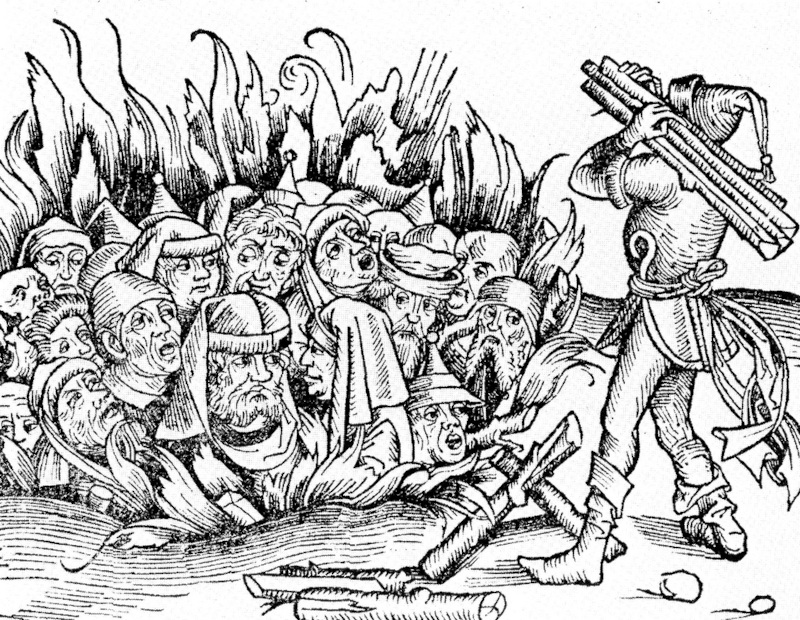
Initially the Basel city council tried to protect their Jews but under intense pressure from the local guilds, they had to give in. They formally expelled Jews from the city in 1349 and wrote a decree that banned them from living in the city of Basel for 200 years. The decree didn’t last 200 years and the authorities in Basel effectively lifted it after the 1356 earthquake. They were allowed back largely because the city needed their financial services and credit. But that shows how the fear of death can manipulate people in unthinkable ways.
The Aftermath: the Dance of Death
Waves of the plague continued for many years, some worse than others. What stayed was the fear of death. The medieval people of Basel turned their fear of mortality into art: the Dance of Death. Around 1431 – 1448, probably still under the bleak shadow of the plague and its many waves, artists painted a large mural on the wall of the Dominican cemetery near the Predigerkirche (Preacher’s Church). It depicted a mortal procession. It showed that death is universal and everyone will die at some point. Clergy, rulers, rich, poor, men and women, simply put, everyone will die. Thinking about it, it was probably less of an arty statement and more like a civic warning or teaching.
The Bacteria
Another Swiss connection comes many centuries later in the form of a Swiss born man named Alexandre Émile Jean Yersin (1863 – 1943). He studied medicine in Marburg and then in Paris. In 1894, when he was 30, the French government and the Pasteur Institute sent him to part of the British Empire, Hong Kong, to investigate a plague outbreak there. This plague looked suspiciously like the Black Death. The symptoms were the same.
His goal was not to investigate the Black Death plague of the 14th century but to identify the germ in the outbreaks in Hong Kong. Yersin was able to isolate a bacterium of victims and showed that it was consistently present in the sick and dead. It was named Pasteurella pestis in honor of the institute where he worked. In 1967 the organism was renamed Yersina pestis after him. Unfortunately he was no longer alive then to bask in his fame. But still, how cool is that? Having a deadly bacterium named after you?
It was probably a logical inference that led Yersin himself, very soon after 1894, to assume that the bacteria was the same one responsible for the Black Death. It was confirmed around 2010-2011 when the extracted DNA from people buried in Black-Death mass graves showed the Yersina pestis bacteria marker.
In Conclusion
To sum up this rather somber post, the plague is still around in parts of Africa, South America and parts of Asia, but very limited. Outbreaks are rare, even though there are no widely used vaccines.
On a really positive note, way back in 1350, at least one of your as well as one of my unidentified direct ancestors were one of the 40-50% of the population that didn’t die in the Black Death. We’re the proof of that. Pretty amazing if you ask me.
 -
- -
-
I think you mean ancestors, not descendants.