
The German saying ‘Gesundheit is nicht alles, aber ohne Gesundheit ist alles nichts.‘ means: ‚Health is not everything, but without health everything is nothing.‘ sums up how important health is.
So obviously keeping healthy is the way to go. But what do you do when something goes awry? Some might just bite the bullet, shrug their shoulders and say ‘That’s life. I either live through it or I die’. Others, possibly the majority of people, would probably trust a doctor to get things moving in the right direction.
But that’s now, 2026, you know what you’re getting yourself into. You know the consequences, and can change directions at the drop of a pin. What was it like in say, 1891 in Southern Germany?
Setting the Scene
In 1891, as far as medicine was concerned, there was still a lot to do. On the vaccine front, a smallpox vaccine had been available since 1882. A rabies vaccine had been available since 1885, it was experimental and expensive. There were no antibiotics at all in 1891 and wouldn’t be until the 20th century. The first one came in 1910 for syphilis. Penicillin wasn’t mass-produced until the 1940s.
Healthcare in rural southern Germany, and Switzerland for that matter, was rudimentary and mostly private or charity-based. There was no national insurance. There was 1 maybe 2 local doctors for rural/small-town care. Home visits was the standard.

Ueberlingen, summer of 1891, end of July, beginning of August. It was a mildly-warm summer, the average temperatures was between 18-20°C. Although the lake moderated the extreme heat slightly, close to the end of July there was a smaller heatwave. That was enough to keep people inside, out of the heat.
Now, imagine a young, poor family of 6 in the town of Ueberlingen on the Lake of Constance, 4 children aged 4, 3, 2 and 1. The father works as a painter and the living quarters are cramped. The youngest child is not at home, probably at his grandparents. The other three are sick in bed with a fever, a barking cough and a swollen neck. The mother or father calls for the doctor. He comes and diagnoses all three children with diphtheria purely by the symptoms.
Diphtheria is a highly contagious, bacterial infection with a high mortality rate of around 50-60%, hitting children under 5 the hardest.
The Tragedy
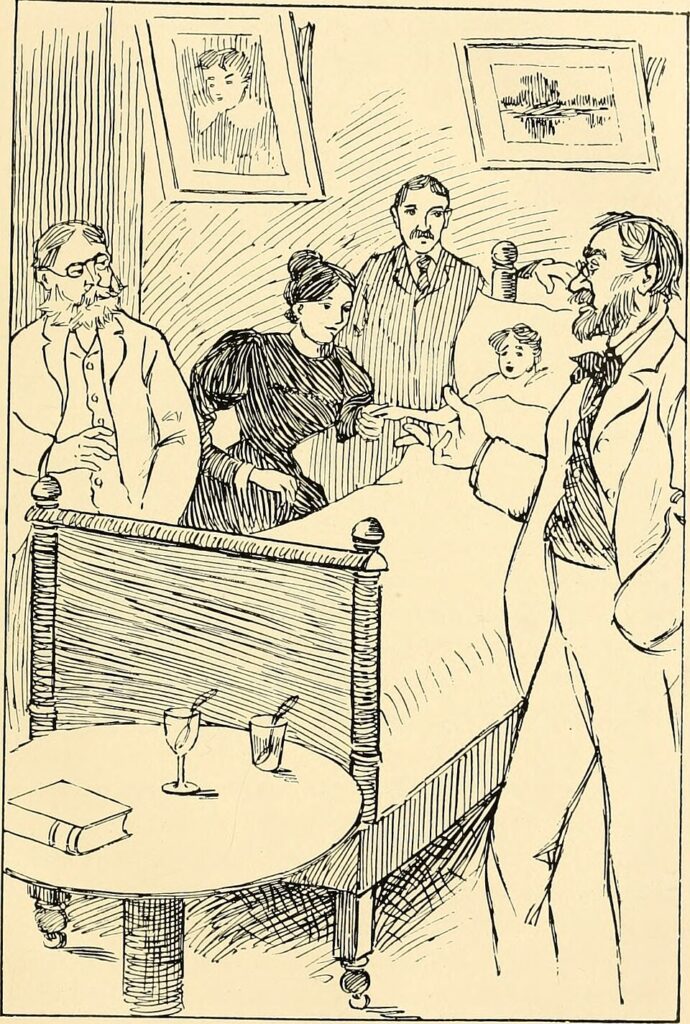
The doctor said that the 3 year old was ‘too far gone’ and decided to concentrate on the other two children and do what he could to save them. We don’t know what treatment he chose for the children, it could have been gargles (vinegar/salt) or possibly a calomel/mercury purge which were horrifying as the doctor tried to purge the toxins and disease quickly from the body. These were desperate ‘Hail Marys’ that the doctors knew rarely helped but had nothing better to offer in their bag of tricks. These purges were finally banned mid-20th century.
The one thing that might have given the children a fighting chance was something called Emile Roux’s serum. But that was first available in 1894. That wasn’t an antibiotic but it was the first antitoxin (antibodies from horses to neutralize diphtheria toxin’s damage) and it slashed child mortality from about 50% to 10 – 25%.
Whatever it was that the doctor tried for the two children that he wanted to help, didn’t work. The 4 year old died on August 3rd and his 2 year old sister died 6 days later on August 9th in 1891. Their brother, who was ‘too far gone’ to merit any treatment, lived until 1963.
The Story Continues…

This sounds a lot like the end of the story but it isn’t. The boy who lived was my husband’s grandfather. As a 3 year old we can be fairly sure that he had no personal recollection of this horrific time in his life. But he knew what happened all too well from his parents and either learned to distrust doctors from them or developed the distrust on his own. Either way he had a solid mistrust of doctors and their abilities all of his life.
So much so that he instilled this mistrust into his three sons who, in turn bestowed the warning to their children. My husband, his siblings and at least one of his cousins now carry that seed of mistrust in them. Some more pronounced than others, but the doubt is there all the same. And, believe it or not, the story has seeped down into the next generation and is growing roots there, too.
This reminds me of a family feud with a hatred or dislike moving from one generation to the next. But in this case my husband’s family isn’t feuding or distrusting another family. It’s doctors they distrust in general.
Luckily many in the family see and know that the medical knowledge of 1891 has changed immensely and advanced for the better. A doctor is not a god and not all-knowing. This person is a man or a woman doing the best they can with the knowledge that is available. A distrust of all doctors because of the tragic outcome of what one doctor did or did not do in 1891, might be going a bit too far.
 -
- -
-