
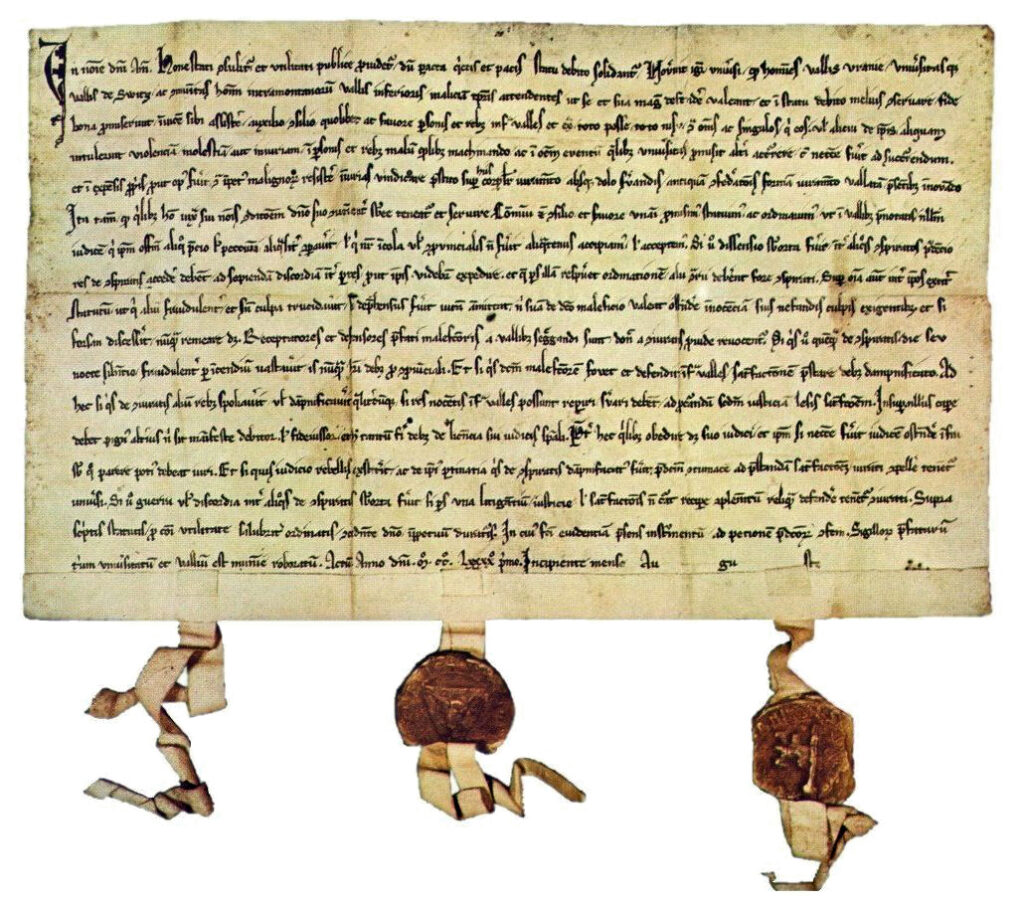
August 1st , Swiss National Day (similar to July 4th in the States), is approaching fast, so no better way to celebrate than by adding to your knowledge of Swiss history and the birth and forming of the nation a lot of us call home. There is no official, exact time when you can say with certainty that this was when Switzerland was born. No declaration of independence to sign, although the Federal Charter or Letter of Alliance of the three cantons Uri, Schwyz and Unterwalden from 1291 comes close. It’s been a long, slow, gradual process with decisive pushes here and there, one of which was in 1802.
What was going on in the world in 1802
To put things a bit more into perspective, Martha Washington, wife of the then deceased 1st president of the United States, died. Ludwig van Beethoven published his Piano Sonata Nr. 14 (Moonlight Sonata) in Vienna. Just a few years prior the electric battery and the metric system had been invented. And, thanks to Europe’s favorite bad guy, Napoleon with his thirst for power, Europe was in turmoil.
As you can see a lot was happening. Among other things there was a ‘War of Sticks’ going on in Switzerland. Although this war with the funny name sounds trivial, it has had long reaching consequences that Switzerland still feels today.
Switzerland at the turn of the 18thcentury
In Switzerland, up to the late 18th century, the 13 allied, sovereign cantons were more or less happily chugging along. Okay, maybe not so happily for everyone. Switzerland was basically run by the upper class and the common folk had no say in any matters whatsoever.
Then, some saw trouble brewing and there was a call to take up arms. Still, the majority of Swiss, being the peaceful folk they are, didn’t respond to the call. So, during a lull in the French Revolution in 1798 France completely overran Switzerland in a matter of weeks. Just like that. Switzerland was proclaimed a Helvetic Republic ‘One and indivisible’. Cantonal sovereignty and feudal, or land rights were abolished. The Republic was suddenly a centralized state based on the ideas of the French Revolution.
But there were problems in this newborn paradise. The upper class were not happy with their loss of power. The simple fact that an alliance with France destroyed the neutrality of the Swiss Confederation didn’t sit well with many. Added to that, the commoners were suddenly forced to feed and accommodate the occupying forces. So no one was really 100% happy. Still, two opposing groups developed out of the new situation, the ‘Unitaires’ who wanted to keep the newly united republic and the ‘Federalists’, who wanted their sovereign cantons back. Fertile ground to squabble and quarrel. So much so that it turned into a civil war. In spite of the obvious instability the French troops left Switzerland in the summer of 1802. Before they left and ‘just in case’, they confiscated weapons in an effort to dampen any thoughts of rebellion. No guns, no fighting, right? Right.
The War of Sticks
They left behind unmotivated and under armed forces of the Helvetic Republic. But, if someone wants to fight, they will. And, they’ll do it with whatever they happen to have around. That’s how the war of sticks began.
Actually it’s called the ‘Stecklikrieg’ which directly translates into the ‘little stick war’. Although no war is a laughing matter, I have to smile when I hear the name. For me, little sticks would be twigs. So, I envision a bunch of big, hurly-burly men running around each slapping the other with teeny-weeny twigs. But it was probably more like a bunch of big, hurly-burly men running around with pitchforks, butcher knives and wooden clubs. Not quite the same amusing visual.
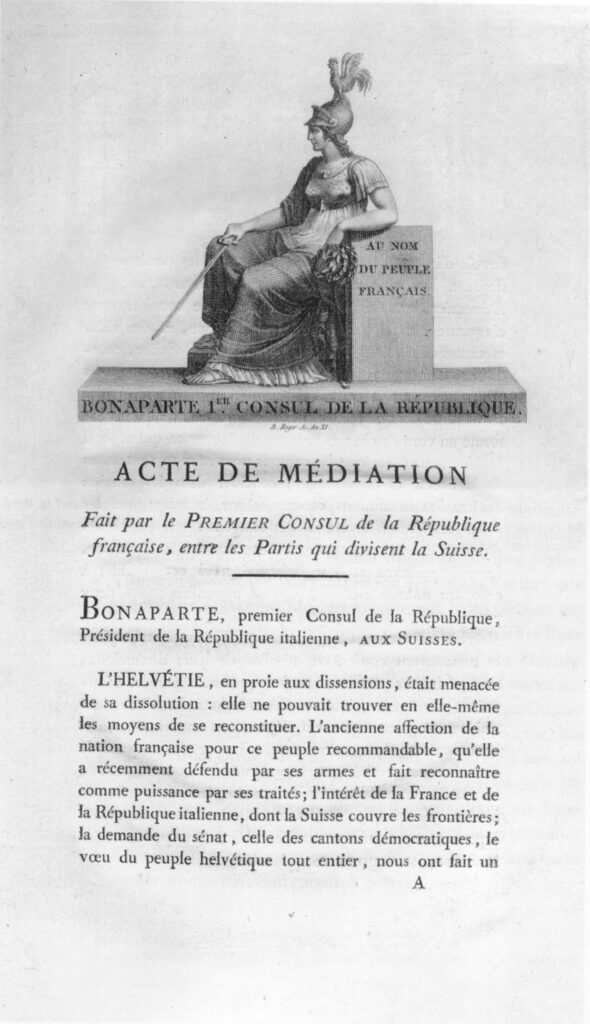
I’m not sure exactly how, but the Federalists won. Then a settlement was needed. Although basically Napoleon was the person who got the Swiss into that situation, he decided he was the man to get them out of it. He realized that forcing any system other than federal on the Swiss was unwise and in 1803 more or less dictated his Act of Mediation. By reducing the size of the Cantons he added 6 new cantons to the original 13 and with that the Swiss Confederation was born. There were to be no more privileged classes or subject lands. Every Swiss citizen was allowed to move anywhere they wanted in the new Confederation and the cantons agreed to respect each other’s constitutions and independence.
Surrender and back to status quo, sort of
Finally in 1815 Napoleonic France’s surrendered. The diplomatic Congress of Vienna tried to clean up the European mess Napoleon left. Among other things, main powers were resized in order to provide Europe the most stability and peace possible. Switzerland didn’t send one delegation to negotiate for Switzerland. Nope. Every canton sent a delegation and frankly that put too many cooks in the kitchen. Each canton was looking out for itself and bickering in plain sight with the others for all of Europe to see. I guess the Swiss hadn’t put the motto ‘Unus pro omnibus, omnes pro uno’ (‘all for one and one for all’) in their hearts yet. At any rate, Switzerland more or less discredited itself with petty bickering and land that could very well have ended up belonging to Switzerland went to Italy, France and Austria.

So, 1802 was a relatively decisive year for Switzerland becoming Switzerland but there have been other bumps along the way. One problem was how Napoleon divided up Berne and the canton of Jura. Switzerland and the canton of Berne are still feeling repercussions of that today. But like I said, it has been a long, slow, gradual process and Switzerland is still working on getting it right.
So until then happens, we’ll just have to celebrate Switzerland the way it is now. Happy August 1st everyone.
 -
- -
-