

Understanding what you see when looking at a 17th or 18th century text can be challenging. This is the second step of three easy steps where I outline how to get around some of the major potholes you can encounter when looking at old texts. The first step was about seeing the individual letters. Thankfully the texts I am looking at use the Latin alphabet which helps. But there is still a lot of wiggle room for it being difficult to read.
Step two is all about forming words with those letters. Sounds easy. So how can I possibly write a post about forming words? Read on and find out.
Step 2: Forming words

In 1700 there were no orthographical conventions used. It was basically a free-for-all. When spelling a word, it looks like the clerks and scribes used any letter order that came to mind which was even moderately close to the pronunciation. It was perfectly acceptable to spell any word, particularly the name of a person or place three different ways on the same page. I think their credo must have been: Wen in daut, yest spel it fonnetikly.
Orthography
The pronunciation of a hard ‘c’ is /k/ as in the word ‘corn’. A soft ‘c’ is usually pronounced as /s/ as in the word ‘necessary’. It seems like using a ‘c’ to produce a hard ‘c’, /k/-like sound was clearly too soft and weak back in the 1700s. So the clerks simply added a ‘k’ or even a ‘ke’ to make it stronger and harder. Sheeze, most of the time they just scrapped the ‘c’ and replaced it with a ‘k’. I guess a ‘c’ would make words like ‘public’ look pathetic (or would that be pathetik?). So they wrote it with a ‘k’ and toughen it up some. Interestingly enough the soft ‘c’ didn’t get changed to an ‘s’, or at least I don’t recall seeing any words spelled that way.
Economics
Although the clerks were economical when dealing with longer and much used words, they threw in ‘e’s at the end of words that didn’t necessarily need to be there. Probably just because it looked goode. ‘Ye olde shoppe’ is an excellent example. But the generosity with ‘e’s ended when they wanted a word to end with ‘ed’, like ‘summoned’. Then they shifted gears to economy, dropped the ‘e’ and wrote ‘summond’.
In an 1860 novel, George Eliot wrote that the English rural gentry looked upon spelling as a ‘matter of private judgment’. It was probably even more so in the 17th and 18th centuries.
Truncation
Economics brings us nicely to abbreviations and believe me, there was no shortage thereof. I got the feeling the clerks often got tired of writing a word because of its length. Maybe they felt that they had already written it so many times before, that the reader should recognize it. For a longer word they just truncated it and then superscripted the last letter or maybe put a line over the shortened word, or both. Easier still, they just wrote the first three letters and added a colon ’:’ and let the readers fend for themselves.
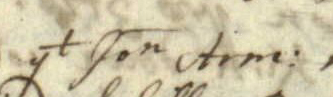
This example shows all three possibilities in two words. ‘John’ is written ‘Jon’ with a horizontal line above it. The next word is ‘Arm:’ which, needless to say, is an abbreviation for Armstrong. But in the clerk’s defense, the name Armstrong appeared so many times in that text that they probably saved many hours writing time and many pages by abbreviating it.
Abbreviations with ‘y’ and ‘q’
What gave me the most headaches though were the abbreviations that started with a ‘y’ or ‘q’ followed by one or more letters. The ‘ye’ was pretty easy to figure out. That was the abbreviation for ‘the’ as in the ‘Ye Olde Shoppe’ example above. The ‘ye’ that meant the pronoun ‘you’ in earlier times, in something like ‘hear ye, hear ye’, had disappeared by then. Or at least it had disappeared in the documents I was transcribing. The ‘q’ took a little longer to figure out but I did, it stands for the sound ‘wh’.
By the way, the key to understanding these abbreviations lies in the Latin alphabet. The ‘y’ isn’t really a ‘y’ but is actually the Middle English letter thorn which indicated the sound /th/. It is a sound that wasn’t in the original Latin alphabet. A thorn looks suspiciously similar to a ‘y’. That makes it obvious why the abbreviation ‘ye’ meant ‘the’. It was also pronounced /th/. So ‘Ye Olde Shoppe’ was pronounced ‘The Old Shop’. The thorn was still known in 1700’s but was slowly moving towards looking like a ‘y’. The letters ‘th’ existed and were used at this time so that the thorn was relegated to common abbreviations.


You can actually see the difference, albeit not a big one between a ‘y’ and a thorn in these two examples (by, ye):
The ‘q’ as an abbreviation has similar beginnings; as you may or may not know, there was no ‘w’ in the original Latin alphabet. The ‘q’, represents the soft /w/ sound it makes, like when speaking French. The letter following the ‘y’ or ‘q’ indicates the last letter, or sound of the abbreviation. Once you how these abbreviations work, life gets immensely easier.
The clerks took abbreviating to extremes. If you don’t believe me just look at these two examples. The word ‘told’ is probably the only decipherable word here and the only one not abbreviated.
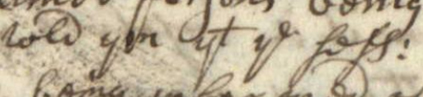
The transcription: told ym yt ye sess: (not fofs: !)
The translation: told them that the session
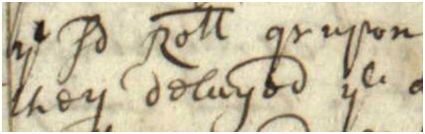
Transcription: ye sd Robt qrupon
Translation: the said Robert whereupon

Here’s another example of an abbreviation that I had trouble figuring out. I thought ‘P’ stood for ‘person’ because it usually (but not always) was before a person’s name. It took awhile, but when I realized that I wasn’t looking at a ‘P’ but at an ‘sd’ everything fell into place.
Of course knowing that the clerks were also the copy machines of their day meant they had to find a way to write quickly and efficiently. So why not abbreviate everything possible? Makes sense to me.
It’s nice to know that there was logic to their madness. Here’s the code-breaker table I made for the ‘y’ and ‘q’ abbreviations, well at least the ones I frequently came across. As you can see, it really is logical.
‘Y’ stands for the sound ‘th’
ye the
ym them
yn then
yr there/their
ys this
yt that
‘Q’ stands for the sound ‘wh’
qch which
qho, qo who
qn when
qr where
qt what
Combining ‘yr’ (there /their) with other letters
oyr other
anoyr another
boyr brother
moyr mother
fayr, fayrd father, fathered
Now that you’ve got the second step down pat you can put those single letters together and form words. And understanding how abbreviations work can save you a lot of headaches. But it’s still missing the all important piece, the third step. That pulls it all together. Step three will be the third and last part in this mini-series.
 -
- -
-