
Dogs are a very common animal. There are a large number of idioms and sayings dealing with dogs. Some are the same in both English and German, others are only found in the German language.
Dogs
Vor die Hunde gehen. Direct translation: to go in front of the dogs.
This is not good when this happens. Not good at all. The saying comes from around the 17th century. Hunting dogs usually get to the sick and weak wild before the hunters do. This usually results in painful and violent deaths. You certainly wouldn’t say something like that in English. I suppose if you were in a hopeless situation you would say that something ‘went down the drain’. Not quite as nasty.
Den letzten beissen die Hunde. Direct translation: the last will be bitten by the dogs.
This is similar to ‘go in front of the dogs’ and means that the dogs get the weakest and slowest. A English saying that deals with biting but not dogs, is to bite the bullet. That would mean to get through an unpleasant situation. The German saying means you certainly don’t want to be the last.
Hundestage. Direct translation: dog days.

Although this term exists in English, I had never heard of it before I came to Switzerland. The dog days are the hottest, sultriest days in the summer: between July 23rd and August 23rd. It has a Greek and Roman astrological background. The brightest star, Sirius, also known as a Canis Majoris (the Dog Star) appears in the northern hemisphere during the summer. It seems during the Antiquity when this star made its appearance a connection was made with heat, drought and thunderstorms. Scientists say that because the star is so far away (8.7 light-years) it has absolutely no effect on the earth. Also because the star shifts relative to the sun, in 10’000 years it will rise in the middle of winter. So that means that the middle of winter will be hot and lots of thunderstorms. Well, taking the climate change into consideration that doesn’t seem totally impossible.
Mir ist hundeelend. Direct translation: me is doggy miserable.
We have owned dogs for many years. I would hope that none of them were miserable. Still, my guess is that dogs haven’t always had such an easy, carefree life. If you say you feel doggy miserable (which you wouldn’t say in English), you mean really, really awful.
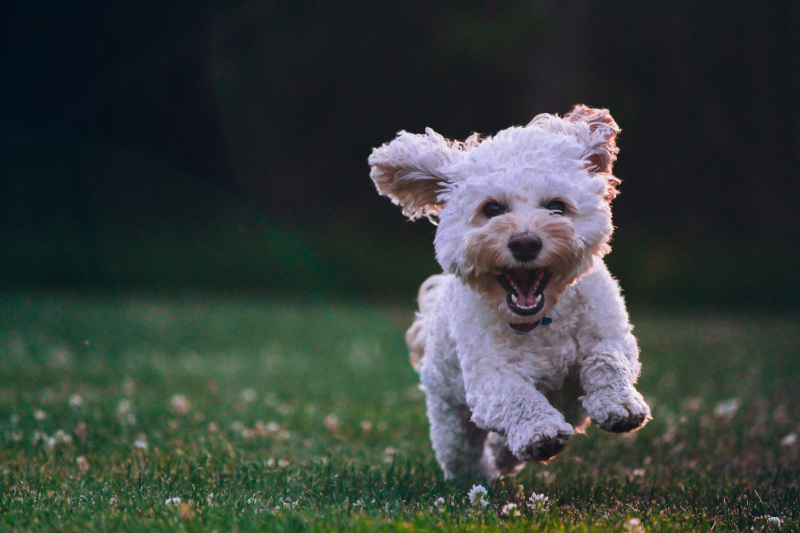
Pudelwohl. Direct translation: poodle content.
In contrast to many dog sayings this has a very positive meaning. It can be translated into ‘fit as a fiddle’, ‘completely contented’ or ‘on the top of the world’. Happy as a lark. Happy, happy, happy.
Das Messer schneidet wie ein tote Hund beisst. Direct translation: the knife cuts as well as a dead dog bites.
Well, how good does a dead dog bite? I’ve never heard this comparison in English but it would certainly be understandable.
Da liegt der Hund begraben. Direct translation: that’s where the dog is buried.
It basically means, ‘Eureka! I found it. Now I understand what the problem is and what caused it.’ It seems that in the Middle Ages it was thought that treasures were guarded by black dogs. They even called the buried treasures ‘dogs’. So, if you know where the ‘dog’ is buried all you need is a shovel and you’re good to go.
Hunde, die bellen, beissen nicht. Direct translation: dogs that bark don’t bite.
In English you wouldn’t go as far as to say that the dogs don’t bite but the saying is similar. ‘His bark is worse than his bite.’ I sort of like the German saying. After all, doing two things at once isn’t that easy. So it makes sense, dogs that are barking, can’t bite. Growling and biting, now that’s a different story.
Ein dicker Hund. Direct translation: a fat dog.
It means that something is unbelievable or scandalous. This phrase has been in use for a long time. It is possible that in the Middle Ages fat dogs were scarce. Obviously in times of famine it would be scandalous seeing a fat dog. If you said this in English, it might harvest some strange looks.
Sie sind wie Hund und Katze. Direct translation: you are like dogs and cats.
Well, everyone knows that dogs and cats don’t automatically get along with each other. Quarrel, quarrel, quarrel.
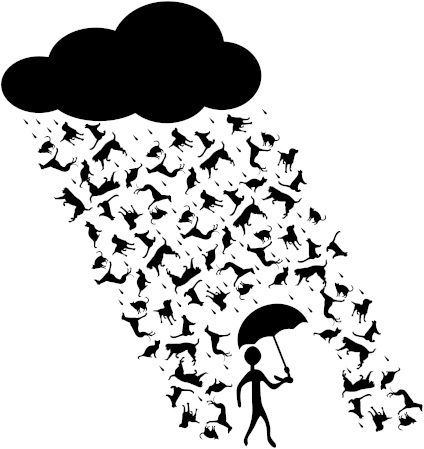
Es regnet Hunde und Katzen. Direct translation: it’s raining dogs and cats.
Besides the fact that in English, for some reason, you would say ‘cats and dogs’ the saying is the same. The saying has been around ages and trying to put a reason to this would be pure speculation. The only thing I can say is, when it’s raining cats and dogs you better have a sturdy umbrella.
 -
- -
-