
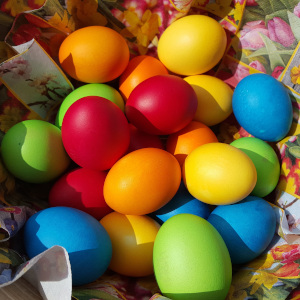
The tradition of eggs on Easter can be traced to pagan celebrations. The pagans believed that eggs represented fertility and birth. Today the new life that emerges from an egg can be interpreted as the resurrection or re-birth of Jesus.
Games
There are many traditional egg games on Easter around the world. Most have no religious significance.
Egg rolling is a race played around the world. In some places children roll hard-boiled eggs down a hill seeing whose egg can go the furthest. In the United States children race to see who can push an egg with a long-handled spoon though the grass the fastest. The most famous of the egg rolling games is played at the White House. Almost every year since 1870 the First Lady hosts egg-rolling and other games to children on the White House lawn. In 2018 the Easter games were held for the 140th time.
I remember a farm near where we lived held an annual Easter Egg Hunt on their grounds. It was a big event with many journalists watching hundreds of delighted children of all ages searching for hidden eggs.
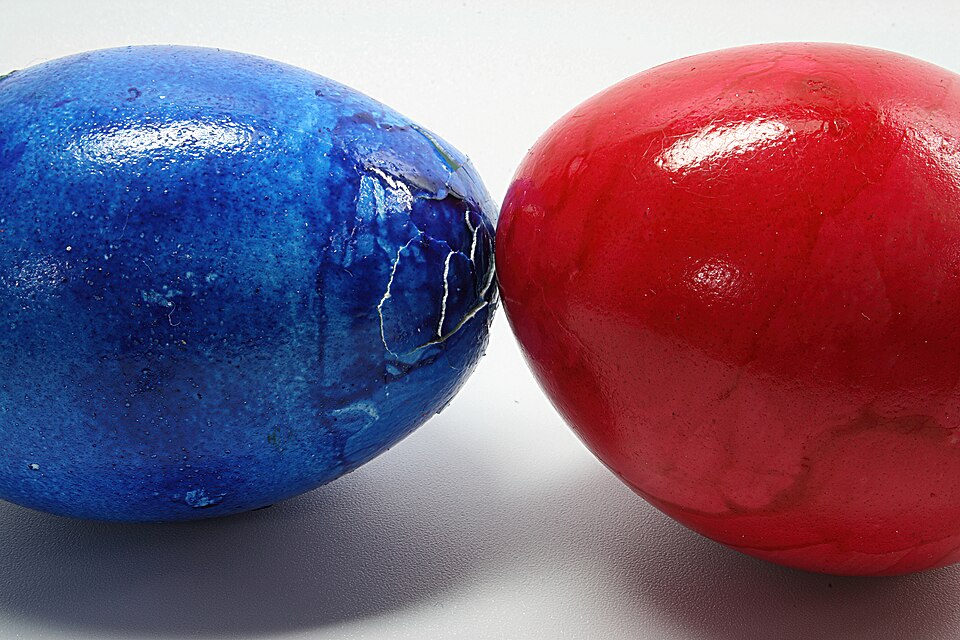
In Switzerland there is an Easter egg cracking game played in Zurich called ‘Zwänzgerle’ [twenties]. That’s where a child challenges an adult to crack their egg with a 20 cent coin. If the adult fails, which is usually what happens, the child gets to keep the money. If the adult does crack the egg then they get to keep their 20 cent piece along with the child’s egg.
In Berne the game is simply called ‘Eiertütsche’ [egg tapping]. The rules are that one person holds a hard-boiled egg and taps the egg of another participant with their own egg. The intent is to break the other person’s egg, without breaking your own. If your egg breaks you have to give it to the winner. This game has been the subject of occasional cheating using unbreakable eggs filled with cement, plaster or similar. Because of this, after a person has broken three eggs with the same egg they have to crack their egg to show everyone that it was real.
Egg Decorating Around the World
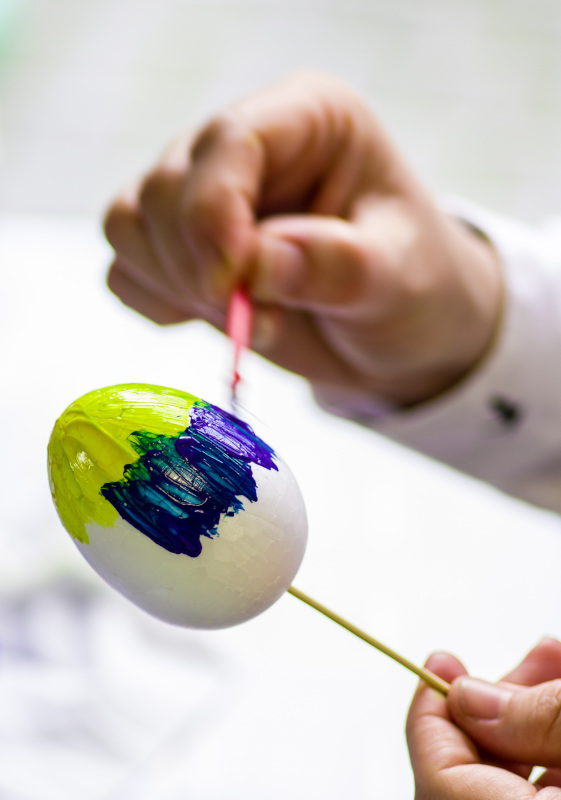
Egg decorating dates back to the 13th century and took place during the spring equinox. As a child in the States (ehm, many years ago), I may have decorated eggs once. I vaguely remember using store bought paint and transferable designs. It must have been a bit of a disaster because we never did it again. But I’m sure other people in America do decorate eggs.
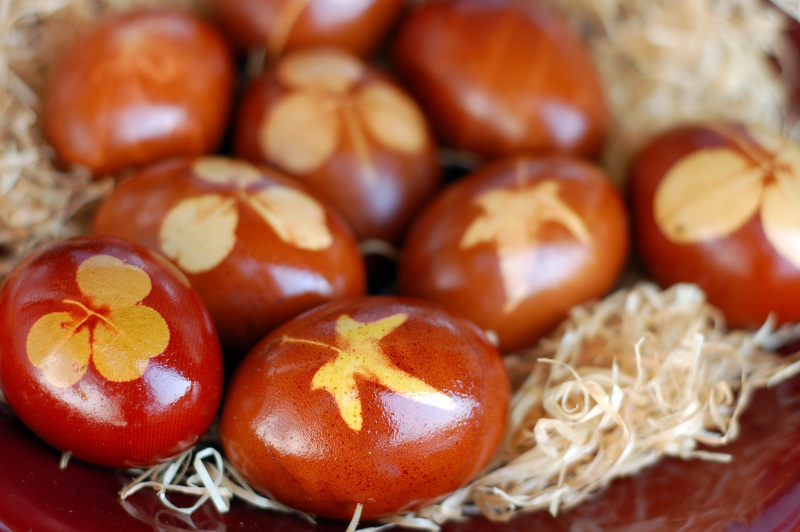
Shortly after I came to Switzerland I saw my husband’s mother buy a bag full of onionskins so she could dye Easter eggs. Although I had never seen that before, using onionskins is probably the most traditional, economical and natural way to dye eggs. She would decorate an egg by putting a small leaf, clover, grass or flower on the egg. She then slipped the egg into a nylon stocking to keep the leaf or whatever from moving and make it stay flat on the egg. Then she hard-boiled the eggs in the onionskin water. My mother-in-law’s Easter eggs were among the prettiest I have ever seen. They were red-brown and had beautiful, unique designs on them.
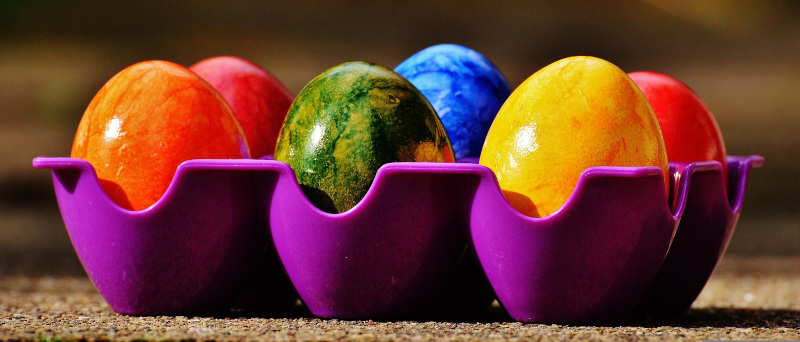
Pre-dyed, colorful hard-boiled eggs takes any work out of dying eggs you might have had. They are sold in every grocery store in Switzerland the whole year ‘round and more so around Easter. Also, I had to come to Switzerland to learn you could eat hard-boiled eggs with a dab of mayonnaise on them. Up to then I only ate eggs with salt.
The epitome of decorating eggs can be seen in the 52 ‘Imperial’ Fabergé eggs. They were made for the Russian Tsars Alexander III and his son Nicholas II as Easter gifts for their wives and mothers. The eggs looked like standard decorated eggs, but they were made from gold and precious stones and each contained a surprise. The first egg in 1885 cost 4,151 Russian rubles. That roughly translates into around 57 thousand US dollars in 2015. The eggs are now scattered across the world. Two of them are resting in Lausanne, Switzerland. Not quite the kind of egg you would want to crack, peel, add a dab of mayonnaise and eat.
As Evan Esar once said, ‘Easter is the only time when it’s perfectly safe to put all your eggs in one basket’.
 -
- -
-