

I really enjoy genealogy, and because so many sources have been digitalized it’s really easy. It doesn’t matter where in the world you start your search. If you’ve got an internet connection you’re good to go. I started my search for ancestors with my husband years ago. We were searching for connections to his side of the family, so there was a lot of German. Okay, all of it was in German with very little Latin. But now, many years later, we’ve started looking at the roots on my side of the family. That has steered us to the Scottish lowlands and the English borders. Although we had done a lot of work and knew how the genealogy thing works, the jump to English from German hasn’t been without its quirks.
Reading and understanding the context of any 17th or 18th century text can be difficult. I realized that the task is doable if you use these three easy steps, well, maybe they’re not so ‘easy’. Step one: you have know what letters in which alphabet you are looking at. Then step two: is forming the words. Step 3 is understanding their context through the sentence structure. Sounds easy enough? Well, think again.
This post is only about the first step. I’ll post the other two steps for you at a later date.
Step 1 – Knowing your Letters

Okay, first you have to figure out exactly which alphabet you are dealing with. There are some pretty wild looking ones out there. Some are so squiggly they look like a series of flowers. Others, like the Cyrillic alphabet uses some symbols that look like Latin letters but really aren’t.
Luckily for us, both German and English are written in using the Latin alphabet. When trying to read older texts it gets obvious pretty quickly that not all the letters look the same as we would write them nowadays. It’s lovely to look at, but words don’t just pop out at you. The visual aspect of word recognition disappears. By that I mean you no longer can recognize words by just looking at them. When that happens I write the word letter for letter. I then look at what I wrote. Usually once I see the word written with the letters I’m used to, I recognize it. The difficulty can be figuring out what the letters are in the first place. Not all letters are created equal and so it can quickly become a bowl of alphabet soup.

This happened to me, I was having problems recognizing letters. Quickly realizing that I needed help, I searched the Internet for tips and tricks but to my dismay I found none. So, with no better options I just dove into the soupy adventure and swam the best I could. After awhile I got better and then got almost proficient. It looks like I can develop survivor skills when I need them. Here’s what I learned about how the letters were written in the 17th and 18th century.
Masquerading letters
The letters ‘y’, ‘i’ and ‘w’
The letters ‘y’ and ‘i’ are interchangeable. They meant the same thing and sounded the same when spoken. So the choice was left to the scribe. Likewise the letter ‘w’ was somewhat troublesome. The thing was, there was no ‘w’ in the original Latin alphabet so it had to be invented. With time they formed it by using a double ‘u’ which looks like a double ‘V’ in Latin. But of course everything takes time, so there was a transition period. During which both variations, two ‘v’s or a ‘w’ were used to represent the sound /w/.
The letter ‘s’
The letter ‘s’ can be tricky because it was written in a variety of ways. At the beginning of words it looks like an ‘f’. The first ‘s’ in a double ‘s’ is also written similar to an ‘f’. A single ‘s’ in the middle or at the end of a word looks similar to what we recognize as an ‘s’: like a backwards ‘c’ or a little vertical squiggle. Of course, if capitalized, it can look like an ‘l’. So there’s a lot of letters an ‘s’ might be masquerading as. Because I learned to read the German cursive script first, that sometimes got in my way. So, not only can an ‘s’ masquerade as an ‘f’ or ‘l’ for me it can also masquerade as a German cursive ‘h’.
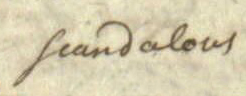
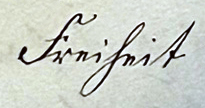
Knowing the different ‘s’s empowers you to read the words ‘fcandalous huccefsfuli’.
The letter ‘c’
A ‘c’ quite often looks like a ‘c’ as in the ‘scandalous’ example above, which is nice. But it doesn’t always look like a ‘c’. Sometimes it resembles an ‘r’ of all things, or an undotted ‘i’. I was usually able to catch these mistakes through context, but not always. Sometimes I came up with something crazy like ‘The witness was ralled.’
The letter ‘e’
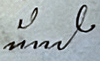
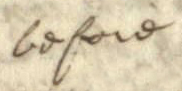
Depending on how neatly the text was written an ‘e’ can easily be mistaken for an ‘o’. The knowledge of the German cursive script occasionally trips me up here, too. The English ‘e’ looks a lot like a German ‘d’ especially when they are at the end of a word. You can see in the two examples how the letters ‘d’ and ‘e’ are written similarly. All you only need a sloppy written text and you have the perfect storm.
Capitalization
Of course the clerks doing all this writing capitalized proper names and places. Or maybe not, I have seen forenames written in lowercase. Your guess is as good as mine as when to capitalize and when not to. But I get the distinct feeling that if they liked the way any letter looked capitalized, they went for it.
So, now you know the basics about how the Latin alphabet was written during the English Renaissance. You can pat yourself on the back because you have taken the first step off of my three easy steps to understanding the context of any 17th or 18th century text. The next step is forming words. So stay tuned, I won’t leave you hanging too long!
 -
- -
-