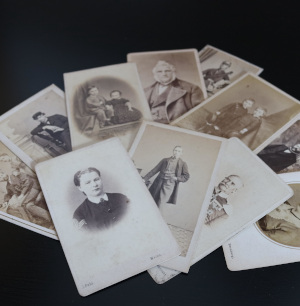
Gathering ancestors and putting together family trees has to do with your personal history. But up to recently I thought that, in general, church birth registers from Scotland didn’t have anything to do with the history of Scotland or England. Which I confess didn’t bother me at all. English history has never been my strongest point. There were just too many monarchs with too many roman numbers behind their names for my liking.
Hitting the Brick Wall and the Church Books
So I just happily chugged along gathering family data and let history be history. Then I hit the infamous brick wall, that happens when your main source of information dries up and you are unable to continue or make further progress. That’s when it’s time to get creative. I hit my personal brick wall researching for Armstrongs around 1700. That was when my John and Sybilla appeared out of nowhere and baptized their child Walter. The baptismal book didn’t go back any further, I was at the end of the road and had to look for other sources. I found church minutes called the Kirk Session Minutes from the place I knew my people lived in at that time. The books were missing quite a few pages and only went back as far as 1694. Not very promising but they were digitalized and the only thing I had. So in hopes of adding something, anything to my knowledge I figured these were better than nothing. I knuckled down and transcribed any entry that had to do with any Armstrong in that parish. But to find any Armstrong I had to read through all of the minutes. Sometimes there was an Armstrong or two hidden in an entry as a witness or something like that. Luckily there were an overabundance of Armstrongs in that area during that time so my search was anything but boring. In the end the number of Armstrongs took up about ⅓ to about ½ of all the entries in the books. So reading and transcribing books of minutes was no small task, to be sure.
I was rewarded for my efforts. I found out that my oldest people, John and Sybilla had gotten married ‘irregularly’ in England, which is probably similar to eloping except the church didn’t recognize it as legal. I also found mention of John’s father so I had a name and place to add to my list! In addition to that it appears eloping runs in the family; their son Richard, born in 1710 eloped in 1745.
Besides these tidbits of information pertaining to my direct lineage I read ad nauseam about pregnant unmarried women, when and where the child was conceived and with whom. The man usually owned up to being the father but not always. Sometimes sparks flew and you could hear the situation sizzle. There was also the occasional irregular marriage, or being drunk, swearing or working on a Sabbath. Once in a while there was a rebellious person who contumaciously tried to get the upper hand in court, but the church always won. Well, except with one couple. The last entry about them stated that they had left the parish. But that was basically the run of the gamut. You walked the straight and narrow or were publicly rebuked and repented for your sins.
An Entry That Stands Out Like A Sore Thumb
Then I read something totally atypical so I perked my ears and tilted my head. It was on October 8, 1745, a couple of months after my Richard, the second son to John and Sybila had eloped with his Mary, the Kirk Session clerk wrote this in the minutes:
‘The session taking into their serious consideration the danger which at present threatens these lands from the wicked rebellion that is now carrying on in favour of a popish pretender to the imminent hazard of our precious liberties, and what is infinitely more valuable of the protestant reformed religion, appoint Thursday first to be observed as a day of fasting in this parish that the Lord in his mercy would defeat the attempts of the pretender and his adherents, and deliver us from those impending evils.’
What in the world was going on that the minister felt the necessity to write something like that? Ben’s father once said that everything in life revolves around three things: sex, money or power. Depending on where you are in life the priority changes. Most of what I had read so far in the church minutes dealt with sex. This certainly wasn’t about sex so the other two possibilities were money or power. I did some research for 1745 and Scotland and this is what I came up with.
The Jacobite Rising 1745
Spoiler alert; it’s about power. The religious part of the equation is almost a side note. The history basically goes something like this. We have one family, the Catholic Stuarts and the Protestant Hanoverians battling for power. It begins in 1688 when the Catholic English King James II (Scottish King James VII, see what I mean about the roman numbers and this was the same person!) was overthrown. He was forced to flee to France by his Dutch, Protestant son-in-law. His daughter Mary took the throne but died in 1694 childless and that was when the real power play began. Who was in the line of succession to the throne? Mary’s Catholic half-brother James thought he was the rightful heir but the 1701 Act of Settlement excluded Catholics from succession. Notice that this act was passed after the Catholic King James was ousted. Tricky, tricky.
The whole ensuing conflict is generally called the ‘Jacobite Rising’ by the Scottish and the ‘Jacobite Rebellion’ by the English. But if you’re looking for a Jacob in this rising you won’t find one. Jacobite literally means ‘James’ followers’. Knowing that suddenly makes sense because these were the followers of James who wanted the ousted King James Stuart’s son James establish as King.
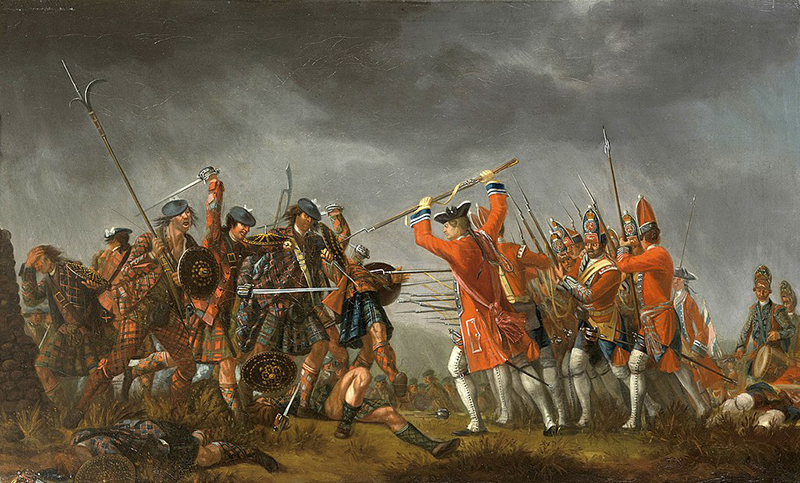
I believe the Jacobites had been pushing for a couple of years in battles and skirmishes to get their Stuarts back on the throne but to no avail. In 1745 Charles Edward Stuart (Bonnie Prince Charles to the Scots and The Young Pretender to the English) and son to James (who was known as the Old Pretender to the English) thought he had found the perfect time to move in for the kill. England was engaged in conflicts in Europe so their attention was supposedly focused elsewhere. Unfortunately what often looks good in theory turns out differently in reality. As was the case here. It started out good and after September they even had time to declare their James King. But slowly after that the Jacobites suffered one battle lost after another and in 1746 there was a crushing defeat in the Scottish Highlands in Culloden that took less than an hour to accomplish. So instead of going in for the kill, their cause had died along with a large number of Scots.
Looking back at the entry in the Kirk Session Minutes you can clearly see which side the Scottish minister was on. He calls it a ‘wicked rebellion’ and sees ‘imminent hazard of our precious liberties’. He asks the Lord ‘to deliver us from those impending evils’ and defeat the ‘pretender and his adherents’. I can only imagine that this must have been terribly important to them if they mentioned it in the minutes.
After the Rebellion
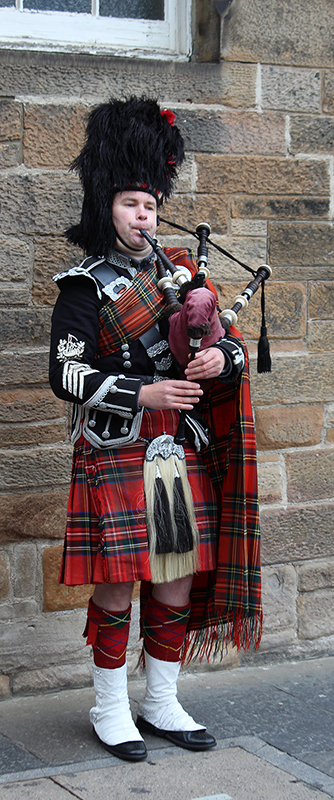
After the English crushed the Jacobite Rebellion they went to work to obtain peace and to break the Scottish rebellious spirit. They felt to achieve that they must ‘unclan’, undress, disarm and teach the Scots to speak English. By disarming they meant to ban anything that could be classified as an instrument of war. That included the bagpipe which was played in battles. So in essence they wanted to take away everything that makes a Scot Scottish, including their rebellious spirit. A daunting task by any standards. So the Act of Proscription of 1746, also called the Dress Act of 1746 was passed. Interestingly enough it was repealed in 1782.
So, those were my first little baby steps into a new world of Scottish history. I was able to keep the roman numbers to a minimum, too. I suppose I could have just stopped with the information about my people and easily enough have left whatever didn’t directly pertain to them out. But understanding what moves these people is just as important as a birth date. It adds a whole new dimension to the lives of my ancestors.
Oh, and where’s the connection to Switzerland? Quite honestly there is none. At this moment Switzerland was enjoying a lull in time. There was a boom in the textile, watch and clock making industries. They were busy keeping their noses out of other people’s business by practicing their neutrality while Europe was simmering all around them.
 -
- -
-