
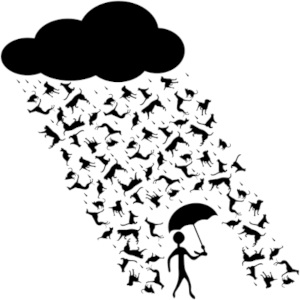
What sounds good and has meaning in one language is often not understandable when directly translating into another. Soon after I learned Swiss German, Ben and I realized how silly some sayings sound when translated directly into English. Sometimes even their meanings in German frequently can only be derived through context and intonation.
Here is a inexhaustible list of German sayings along with a direct translation and what they really mean.
Alles rächt sich irgendwann.
Direct translation: Everything revenges itself at some time.
Meaning: What goes around comes around.
Da stehen mir die Haare zu Berge.
Direct translation: There stands me the hairs to the mountains.
Meaning: I am scared or horrified.
Das ist unter aller Sau.
Direct translation: That is below all pig.
Meaning: That is very bad.
Du bist auf dem Holzweg.
Direct translation: You are on the wooden path.
Meaning: You are totally wrong.
Du hast einen Sprung in der Schüssel.
Direct translation: You have a crack/jump in the bowl.
Meaning: You are somewhat crazy. You are not playing with a full deck.
Er hat uns einen Strich durch die Rechnung gemacht.
Direct translation: He made us a line through the bill.
Meaning: He stopped our plans.
Er kommt bei den Mädels gut an.
Direct translation: He arrives well at the girls.
Meaning: The girls like him.
Friede, Freude, Eierkuchen.
Direct translation: Peace, joy, pancakes.
Meaning: Exaggerated harmony.
Geh wohin der Pfeffer wächst.
Direct translation: Go where the pepper grows.
Meaning: Get lost and never come back.
Hier ist tote Hose.
Direct translation: Here is dead pants/trousers.
Meaning: It is boring here.
Ich glaub’ ich spinne.
Direct translation: I think I spin (as in spinning wheel).
Meaning: I must be crazy.
Jetzt geht es um die Wurst.
Direct translation: Now it’s going around the sausage.
Meaning: An important decision is about to be made.
Jetzt weiss ich wie der Hase läuft.
Direct translation: Now I know how the bunny runs.
Meaning: Now I know how it works.
Keiner kann mir das Wasser reichen.
Direct translation: No one can reach me the water.
Meaning: No one is as good as me.
Komm schon… Spring über deinen Schatten.
Direct translation: Come on… jump over your shadow.
Meaning: Come on, overcome your problems and do the right thing.
Mein Englisch ist nicht das Gelbe vom Ei. Aber es geht.
Direct translation: My English is not the yellow from the egg. But it goes.
Meaning: My English isn’t the best but it’s okay.
Möchtest Du mich für dumm verkaufen?
Direct translation: Do you want to sell me for stupid?
Meaning: Do you want to trick or fool me?
Reiss dich zusammen.
Direct translation: Tear yourself together.
Meaning: Pull yourself together. Get your act together.
Sesamstrasse: Der, die, das, wieso, weshalb, warum…
Direct translation: Sesame street: The, the, the, why, why, why…
Meaning: The, the, the, why, why, why… Sorry, I’m in over my head here. The first are gender words that are non-existent in English. I believe the “w” words are case related.
Sie hat ordentlich Holz vor der Hütte.
Direct translation: She has neatly wood in front of the cottage.
Meaning: She has big breasts.
Spiel hier nicht die beleidigte Leberwurst.
Direct translation: Don’t play the offended liver sausage.
Meaning: Stop pouting or being offended.
Was ist das für ein Saftladen hier?
Direct translation: What’s this for a juice shop here?
Meaning: This is a bad or customer unfriendly company or place.
Wie du mir so ich dir.
Direct translation: How you me so I you.
Meaning: What you do to me, I’ll do to you. I’ll pay you back.
Translating via Internet
When the Internet was young Google set up a translation service. Many of the above translations could very well be early Google translations. Years ago, to see how bad it really was we tried it out on a greeting: Ladies and gentlemen. We let Google translate it from German into different languages and back into English. Here are the results.
German: Sehr geeherte Damen und Herren
English: Ladies and Gentlemen
Franz: Mesdames et chevalier
Spanish: señoras y caballeros
English : Ladies and riders
German: Damen und Passagiere
English: Ladies and passengers
It was amusing to say the least and now you know how to greet people Google-style in different languages.
Maybe five years ago the son of a friend of mine asked me if I would correct his English paper. I said sure and he sent it to me. After reading it through a couple of times I basically understood what he wanted to say and corrected it. I returned the corrected copy with my comment that it wasn’t too bad but read like a Google translation. His mom laughed said “It read that way because it was a Google translation!” Well, well. Room for improvement but Google has come a long way, baby.
So you lucky mushroom, now you know how the bunny runs!
 -
- -
-