
Between 1429 and 1731 Switzerland put a total of around 10,000 men and women on trial for witchcraft. About 60% of them were executed, usually burnt at the stake. A sad set of numbers. In 1782 Anna Göldin was the last person to be tried as a witch in Switzerland. She was executed 239 years ago on Thursday, June 13th and all this happened during the Age of Enlightenment, how in the world did this come about?
During the Renaissance the most common concept about witchcraft was that it was evil and based on a pact with the Devil. They used supernatural resources which resulted in harm to innocent people. Death by torture and much scapegoating were the results of the witch-trials. These trials were also used to tighten a political grasp over the people and impose social discipline. Superstition was renounced and the number of trials slowed down and finally ceased during the Age of Enlightenment.
I’m not trying to lessen the horror of the Swiss witch-hunt numbers in any way, but witch-hunts weren’t only a Swiss thing. This kind of torture and religious fanaticism was happening all over Europe and in the United States. Mention Salem, Massachusetts and you immediately think of the witchcraft hysteria that happened there between 1692 and 1693.
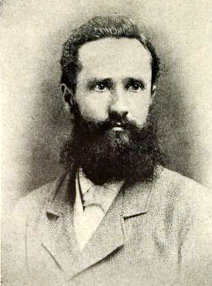
At nearly the same time as Switzerland’s last witch-trial, the last charge of witchcraft was also brought to trial in America. A Mr. Daniel Spofford was accused of exercising mesmeric powers on the invalid Lucretia Brown. Before the lawyer could read his bill of complaint the Judge declared that it was not within the power of the Court to control Mr. Spofford’s mind. The case was dismissed. Bizarre, but short and to the point.
Unfortunately the result of the last witch trial in Switzerland didn’t have such a positive outcome as Mr. Spofford’s. Well, not for Anna Göldin, anyway.
Who was Anna
She was one of eight children born on October 24, 1734 to a poor family. At the age of 15 Anna was earning money as a maid. When she was 31, she got pregnant and had a baby. The infant died during its first night and Anna was charged with suffocating it. As a punishment she was tied to the pillory and put under house arrest. She escaped to the canton of Glarus, a separate sovereign and found work there as a maid.
There, the landowner’s son got her pregnant and she gave birth to a boy. A permanent relationship like marriage, due to their social differences, was out of the question. She was employed by different families and in 1780 she found a job working as a maid in the household of doctor Johann Jakob Tschudi. The Tschudi family belonged to the wealthy elite in Glarus. He was a physician, judge, councilor, and a dignitary of the canton, in short, a man of power.
The Charge
One morning, one of the Tschudi daughters found needles in her milk. Anna was immediately fired from her job because she had prepared the drink. Two weeks later the other daughter vomited pins and other metallic objects. Despite the fact that Anna had left the residence two weeks prior, Mr. Tschudi brought charges against her. If anyone other than Mr. Tschudi had alleged that Anna had put a curse on his daughter nothing would have happened. But because Mr. Tschudi had made the accusation things happened.
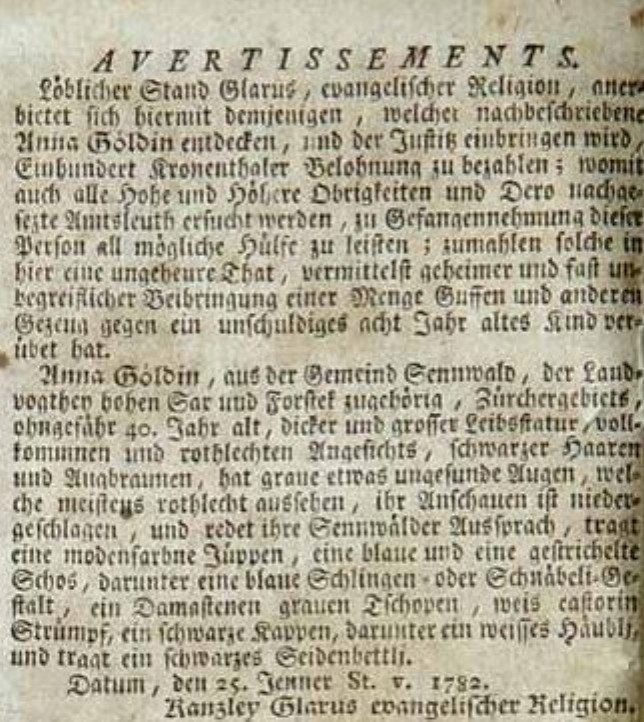
An announcement that was published in the ‘Zurich Newspaper’ [Zürcher Zeitung] to help capture Anna Göldin contained a dangerous undertone. It said they were looking for an approximately 40 year old woman with a ‘fat and large physique’ and ‘somewhat unhealthy eyes’. A reward of 100 Kronenthalers (crowns) would go to whoever captured her. It wrote about a tremendous, secret, and the almost incomprehensible deeds committed against an innocent eight year old child. Basically it said: Attention, witch!
Anna was found and brought back to be charged for her crime.
The Trial
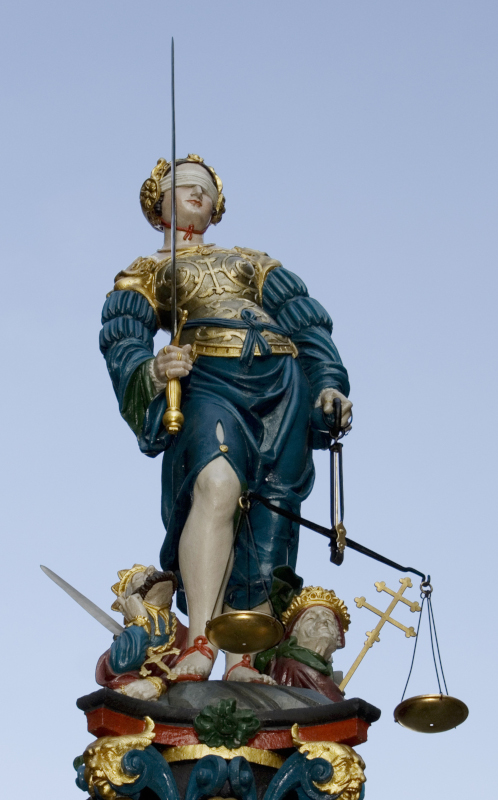
She stood trial and denied the charges. But after being subjected to a pull and stretch torture at least three times, she confessed to having ‘corrupted’ the girl. Extracting confessions by torture was abolished in 1851 so the court was well within the law to do this. With a vote of 32 to 30 she was sentenced to death* for her crime. Interestingly enough she wasn’t convicted of witchcraft per se. After all, Mr. Tschudi was an elite, educated man who certainly, like other educated men of the time, renounced superstition. No, she was convicted of poisoning the child, not of witchcraft. That meant that her death would not come from being burnt at the stake, she would be decapitated.
What Could have Happened
The least likely explanation of what happened was that Anna had put some kind of spell on the child.
What makes more sense could be that the one sister had put the needles into the other sister’s drink. Eight year olds often do things without thinking about the consequences. Two weeks later the second sister retaliated and somehow got the first sister to eat the needles, which luckily she later vomited. Not very pleasant but no telling what sisters might do.
Assuming things happened that way, it’s possible that Mr. Tschudi saw his chance to permanently get rid of his maid. He had already fired her but she was still out there and could gossip. He more than likely had had an affair with Anna and perhaps for reasons of her own, wanted to reveal it. Adultery was considered a capital crime so that’s certainly not something you want people to be gossiping about. That would have tainted or even ended Mr. Tschudi’s social and professional life. Add that to the importance of what such a powerful man says and you’ve got the makings of a perfect legal murder.
The fact that Jakob Tschudi wanted an official document confirming that he had never touched Anna Göldin strengthens the idea of an affair. Obviously he wanted to free himself of any possible backlash from the trial.
Anna Göldin was 47 when she was beheaded by sword on June 13, 1782.
After Her Death
There were journalists at the time who took up the case and denounced it as a scandal. The historian and publicist August Ludwig von Schlözer connected the term ‘judicial murder’ to the case. The term has since been used for all forms of murder carried out under a government’s arbitrary powers. Eventually things got quiet around the case of Anna Göldin.
Then, in 1982 the “Göldi case” struck a chord when it was revived in a novel by Eveline Hasler. It was one of the first books I read in German and I was fascinated by it.
In September 2007 the case was acknowledged as a miscarriage of justice. The extent to which the injustice remains a part of life in Glarus can be seen in the fact that in 2008 she was officially exonerated. The grounds were that she had been subjected to an ‘illegal trial’.
The Anna Göldi Museum in Mollis is dedicated to the history of the ‘last witch’. The Anna Göldi Foundation has award a human rights prize once every two years since 2009.
The watered down, American, Halloween version of a witch that I grew up with, is markedly different from the idea of a witch in the 18th century. Life in 1780’s in Switzerland certainly had its dark sides and it must have been horrible to be trapped in a society that wielded their political power and decided fates. Luckily Switzerland is continually trying to better itself and its wrongs, even if it does sometimes take a while.
*It took Switzerland fairly long to finally abolish the death penalty for good. Before 1942 and the introduction of the Swiss Criminal Code, each canton had its own criminal law.
 -
- -
-