
It’s everywhere there’s no denying that. English words are in the German language to stay. But there are a lot of similarities in the two languages without having to dig around in the fashionable words of today. And when the languages were developing there were no ‘beamers’, ‘flippers’, ‘handy’ and certainly no ‘basecaps’ which would be the German-English word for ‘baseball caps’. You’ve just got to love how German speakers throw English words around and make them their own.
Of course not only the newer, fashionable words can trace their roots to English. There are basic words in Swiss German that come from English, too. That’s because both English and Swiss German are Germanic languages that have been developing since the Iron Age. And just how many years has this been going on? 2,500 give or take a few I believe. Anyway, that’s about how long Swiss German has been stealing, or to put it nicer, borrowing words from English.
Germanic Languages
But do you know what Germanic languages are? I’m not an expert in language, heck, I can’t even speak Swiss German without mistakes. But this is the way I understand the whole language beginnings.
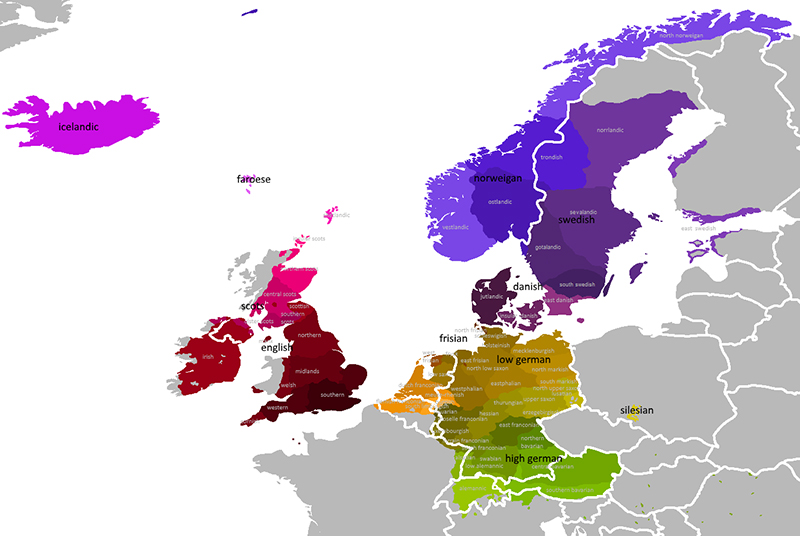
When I first saw the term ‘Germanic language’, I, like many other people thought ‘Ah, yes, the word ‘German’ is right there in plain sight. So that’s probably just a cool, scholarly way to talk about the German language!’. Wrong, so wrong. The German language is part of the Germanic language. Languages that fall into this category are a branch of the Indo-European language family.
The Beginnings in Scandinavia
These languages are all derived from the language spoken in Scandinavia, what is now Northern Germany during the Iron Age. That language slowly developed over the millenniums. First splitting up in three cardinal directions: North, East and West and then growing into individual languages; Scandinavian, German and English. So, all the languages spoken in one direction, although they have significant differences, have some remarkable similarities. An example would be the alphabet, the sentence and word structure and a substantial number of the same words. But what’s really cool, when you know and speak one of these languages, learning another one is easier than learning a language from a different region.

In my post ‘Low Budget Lodgings and How to Save Money’ I wrote about an encounter my husband and I had while visiting Denmark, mentioning that we understood the gist of an argument two Danes were having in front of us. That was possible thanks to the fact that Danish, English, Swiss German and High German all belong to the Germanic language. Of course, just because we understood what was being said didn’t mean we could automatically speak it ourselves and take part in the exchange. But still.
English in Swiss and Vice Versa
So learning Swiss German is certainly easier when you know English because the two languages grew up together. ‘Go look’ in Swiss German would be ‘go luege’. Although ‘luege’ isn’t exactly English, it’s pretty close and in both words the first part is pronounced the same. Of course this example doesn’t match up in all the tenses because it can’t. Bernese-German has no future tense. But don’t let that fool you into thinking that Bernese-German has no future! To build the future tense all you have to do is use time-qualifying words like ‘tomorrow’, ‘next year’, ‘in an hour’ or something similar to that.
Jump! Gump!

Now we can jump to the next example, um, the word ‘jump’. In Swiss German the term used is ‘gump’ and, yes, that is pronounced the same as ‘Gump’ in ‘Forrest Gump’. You don’t need to look hard to see the similarities in the two words. But it looks like Swiss German didn’t snatch the word from English, it happened the other way around sometime during the Middle Ages. I guess until then no one who spoke English ‘jumped for joy’. Or if they did, it probably described as ‘twitching up and down, moving off the ground with joy!’. Or maybe not. Like ‘jump’ the word ‘twitch’, ‘zwick’ in Swiss German, is also derived from the East Germanic language, German. So I guess we can’t chalk those words up to ‘English in Swiss German’ but it’s an interesting find nonetheless. Obviously both languages profited from the other.
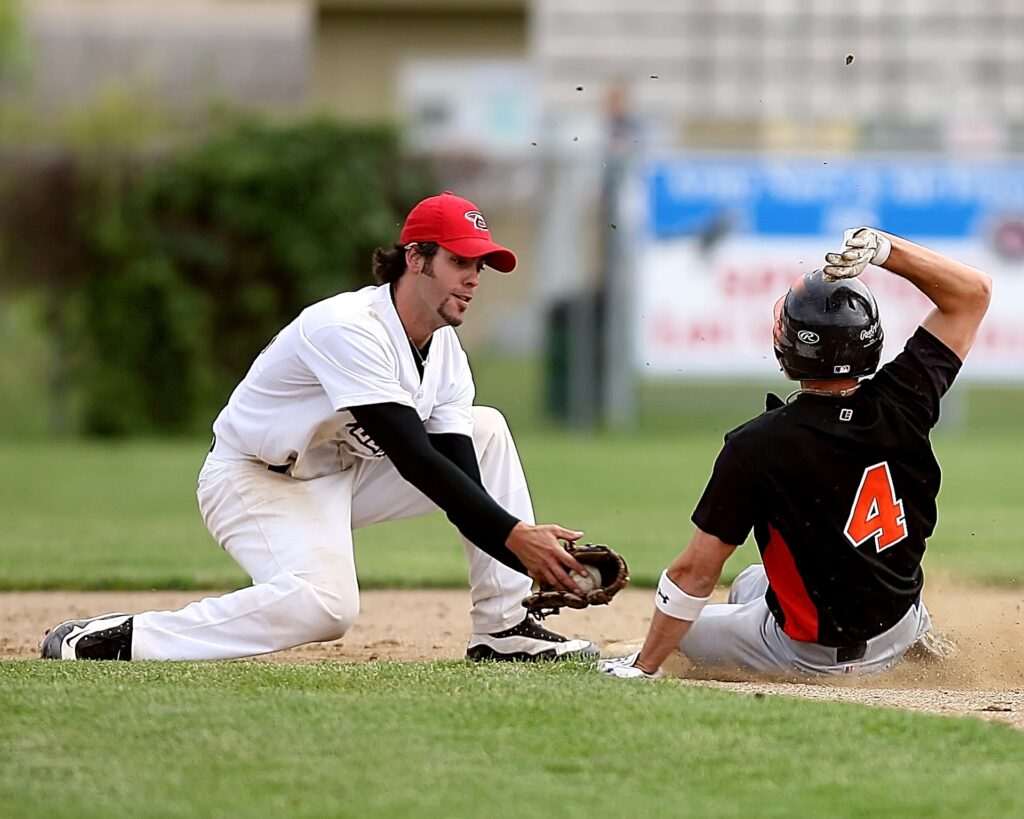
But there isn’t just a back and forth between English and Swiss German. Some say that the English language has taken the most words from non-Germanic languages. Even in the above example the word ‘joy’ stems from the Old French word ‘joie’. It seems that a good number of English words are derived from French and Latin. Keeping that in mind let’s take another look at the word ‘basecap’. Remember how I said the German took the words ‘baseball cap’ and shortened it to ‘basecap’? Who knows, it might just as well have been Swiss French speakers or Swiss-German who know French that changed ‘baseball cap’ into ‘basecap’. After all, in French you call ‘basketball’ ‘basket’ and for ‘football’ you just say ‘foot’ so it only makes sense that you would drop the ‘ball’ in the word ‘baseball’ and turn ‘baseball cap’ into ‘basecap’. Logical, right?
Image sources: Wikipedia, pixabay.com
 -
- -
-