

It happens all the time. When you are learning a new language you are constantly trying to figure out what all the new words mean. Combining the known with the unknown. Maybe the new word is a diminutive or a plural of a known word. Sometimes it works, sometimes it doesn’t. It doesn’t take a lot and the perfect mix-up can occur.
A Dog’s Name
An American friend of mine wanted to buy a puppy. Although she could speak German somewhat, she was still in the beginning stages of learning the language. Mixing High German with Swiss dialect and messing up pronunciation was part of the daily routine. She saw an advertisement in the newspaper that someone was selling a pup named Ruedi. That made her laugh because her father-in-law’s name was Ruedi. In Switzerland Ruedi is the short form for Rudolf. She imagined calling the dog ‘Here, Ruedi. Sit Ruedi. Roll over Ruedi.”
Thinking it would be amusing to have a dog and a father-in-law with the same name, she showed the ad to her husband. He looked at it and missed the joke completely. ‘So? Someone is selling a male puppy.’ It took a while but they were able to clear up the mistake.
What she thought was the dog’s name turns out to be the word for ‘male dog’. ‘Rüde’ is not another way to say ‘Ruedi’ but means a male dog. In the end they did buy a pup but didn’t name it Ruedi.
Welcome
We have Swiss friends who moved to the Dominica Republic a few years ago. In preparation for the move they learned Spanish which they needed because they were going to build a restaurant there. Shortly after the construction started a manager came up to my friend. He held out his hand and said ‘Bienvenido’ which means welcome. My friend said, ‘Thank you’ and in an attempt to make some small talk asked his name. The man replied ‘Bienvenido’. My friend thought ‘that’s mighty nice of him’, thanked him again. This went back and forth for a while in the Abbott and Castello style of ‘Who’s on first’*. At some point my friend realized in a slap on the forehead moment, that was this person’s name!
They’ve been there many years now and I’m sure their Spanish has improved greatly since then.
Exactly Who’s Coming?
Somehow it’s satisfying to know that language misunderstandings don’t only happen to people new to a language. Many years ago someone told me a story of what happened in the Swiss Army. They were doing some sort of a maneuver and couldn’t move something large out of the way. After unsuccessfully trying different ways the commanding officer more or less gave up. He told the troop ‘we’ll just have to wait until ‘Habegger’ gets here.’ Habegger is a relatively common Swiss last name.
So the troop waited. All the while wondering what kind of super human Goliath this Habegger fellow was. He was going to do alone what a whole troop couldn’t manage together?
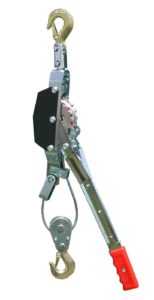 When ‘Habegger’ finally showed up it was obvious he was going to be able to do the work because it was a machine. It’s sort of like a wrench that has a ratchet so you can tighten a wire or rope without having it slip back. By doing this you can slowly pull or hoist very heavy objects. In English this thing is called a ‘come-a-long’. I can only imagine the conversation in English. Who’s going to come along to help pull this out?
If I get caught in the situation where I’m not sure what’s going on I put on my ‘I’m not a native’ hat and ask.
* Who’s On First – Demystified
For my Swiss friends let me explain the mix-up here. The famous, fast paced Abbott and Castello classic comedy routine is about a baseball team player’s names. In baseball you’ve got positions on first, second and third base and between second and third is the shortstop, a pitcher, catcher and three outfielders (left, right and center).
Abbott wants to know the player’s names. The names or nicknames are somewhat strange:
Position: Name of Player
First base: Who
Second base: What
Third base: I Don’t Know
Left field: Why
Center field: Because
Pitcher: Tomorrow
Catcher: Today
Shortstop: I Don’t give a darn
 -
- -
-