As I’ve mentioned before, German is a descriptive language. Some words just bring up a visual. Here’s my certainly not finite list of descriptive animal names [along with the English direct translation]. I knew the majority of them. But I must admit that Ben told me a couple that I neither knew in German nor English.
Direct Translations of Animal Names
Lazy Animal
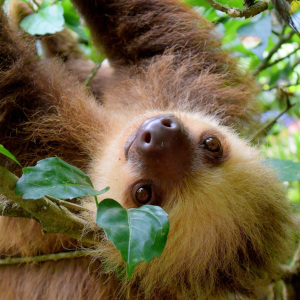
Faultier = sloth. I only knew what a sloth was though the movie Ice Age, the sloth Sid. What’s that called, secondary learning?
Fluttering Mouse
Fledermaus = bat. That makes sense; look, a mouse, fluttering away!
Flying Dog
Flughunde = Keeping with the bat-theme these are megabats. They are also known as fruit bats or flying foxes. Wait. Flying foxes? That sounds like flying dogs.
River Horse
Flusspferd is also called Nilpferd [Nile horse] = Hippopatomus. Oh my! I suppose most people don’t realize that hippo means horse and patomus means river in Greek! So the German and English are pretty similar.
Belted Animal
Gürteltier = Armadillo means little armored one in Spanish. That really is what they look like. So English, or rather Spanish is more descriptive than German.
We saw one of these on a road while travelling in Arizona. Unfortunately in spite of its armor, it didn’t make it to the other side.
Ocean Piglet or Little Sea Pig
Meerschweinchen = Cavia porcellus, or colloquial “guinea pig”. These are neither pigs nor do they come from Africa or an ocean. The name porcellus is Latin and means “little pig”. Where the word “guinea” originates is up to debate. It seems that Guinea used to be used to refer to any far-off or unknown place. So in English we are talking about a little pig from an unknown place.
A guinea pig is a common epithet for test subject. This is because guinea pigs have been used since the 17th century for biological experiments. If you said in German that you felt like a ‘Meerschweinchen’ you would get some odd looks. You would have to say that you felt like a ‘experimental bunny’.
Muttering Animal, Marble Animal
Murmeltier = groundhog. The first time I heard ‘murmeltier’ I didn’t know it was a groundhog and thought of an animal playing marbles. Wrong, it has nothing to do with marbles but does mutter somewhat when startled.
The Swiss connection comes from the Pennsylvania Dutch. A lot of the emigrants in the 17th and 18th century were from Switzerland. The language they speak today is still understandable to Swiss. They had a superstition or rather a long range weather forecast from groundhogs seeing their shadows. February 2nd is traditionally called Groundhog Day.
Groundhogs are also called woodchucks which brings us to the famous tongue-twister/alliteration question. How much wood would a woodchuck chuck if a woodchuck could chuck wood? Of course the answer is simple. A woodchuck would chuck as much wood as a woodchuck could chuck if a woodchuck could chuck wood.
Naked Snail
Nacktschnecke = slug. Not much fun when camping and you wake up with one of those in your hair. Maybe why I’m not big on camping. Uugh!
Ox Frog
Ochsenfrosch = American bullfrog. The difference being an ox is a castrated bull. Both languages lean towards some kind of big, rather aggressive frog.
Schield Toad
Schildkröte = is this a toad carrying a shield? More like a toad covered in armor. A turtle!
Beak Animal
Schnabeltier = a duck-billed platypus. I had never heard of this animal which is found in Australia and Tasmania. Platypus comes from Greek and means flatfooted. There you have it, it’s a flatfooted duck with a bill! English is more descriptive than German.
Sea Elephant
Seeelefant = are actually called elephant seals which are earless seals. These seals don’t have trunks so I guess in this case elephant just means big!
Sea or Lake Dog
Seehund = seal. And here you thought a Labrador Retriever was the original lake dog.
Sea Cow, Round Tail Lake Cow
Seekuh, Rundschwanzseekühe = manatee. The word “Manatee” comes from the Carab word manti, which means “breast” or “udder.” Wouldn’t you know, they’re also known as sea cows! Both cows and manatees are plant eaters. The manatee is believed to be very distant cousins of elephants and not cows. So I guess that would make them sea elephants. No. Wait. A sea elephant is something different. Sort of. This is getting confusing.
Stinking Animal
Stinktier = skunk. The English word originates from the Algonquian language and means “to urinate”.
Ink Fish
Tintenfisch = squid. When Ben was young his family vacationed in Mallorca. At a restaurant his brother ordered squid in its own juice. Ben said that it really looked like someone had dumped a bottle of ink onto a non-definable cooked something. What did it taste like? Ben’s not sure but he assured me that his brother ate it and said it was good.
Eats a Lot
Vielfrass = I was thinking this could be some kind of bird but no, it is a wolverine.
Washing Bear
Waschbär = raccoon. The animal is native to north America and the name originates from the now extinct Powhatan language. It means “the one who rubs, scrubs and scratches with its hands”. Well, there you have it, the German description fits; it’s a bear that washes!
I had never heard of the last animal name.
Horn Ox
Hornochse = This sounds like it could be a rhinoceros but it isn’t. In German that would be a “Nashorn” [nose horn]. A “Hornochse” isn’t an animal at all! It’s an idiot! Since an ox is a castrated adult male cattle I guess a horn ox can only be a male. I lucked out on that one.
 -
- -
-