

It’s always good to be informed of what’s going on locally and globally. What better way than to watch the news on TV.
When I was a child my parents generally didn’t let my brother, sister and me watch the news. There must have been some pretty nasty things shown, after all, the Vietnam war (1954 – 1975) was going on. We weren’t completely shut out of watching TV though. There were special events I remember seeing; the JFK funeral (1963) and the moon landing (1969).
Gradually I eased into watching the news on TV as I got older.
News Format
With the exception of the language, the transition from the US news to Swiss news was easy. Everything looked the same. There was the anchorman with a stack of paper with notes in front of him (in case the teleprompter broke). He presented the news from behind a desk. Intermittently a journalist report something directly on-site. Which is exactly the way the news was presented in the States.

What I’ve noticed is Switzerland shows a lot more global news. In the States the news I saw was very local, occasionally state wide. Only if something really big happened in the world and was somehow connected to the States did it find its way into the nightly news. It’s pretty much like that now, too. When I talk to my sister on the phone about something that happened globally her answer is more often than not ‘Huh?’. On the other hand, it can happen that Swiss TV focuses their whole news coverage on Switzerland. When this occurs Ben, my husband, usually says something like ‘Didn’t anything happen in the world today?’.
TV News Today
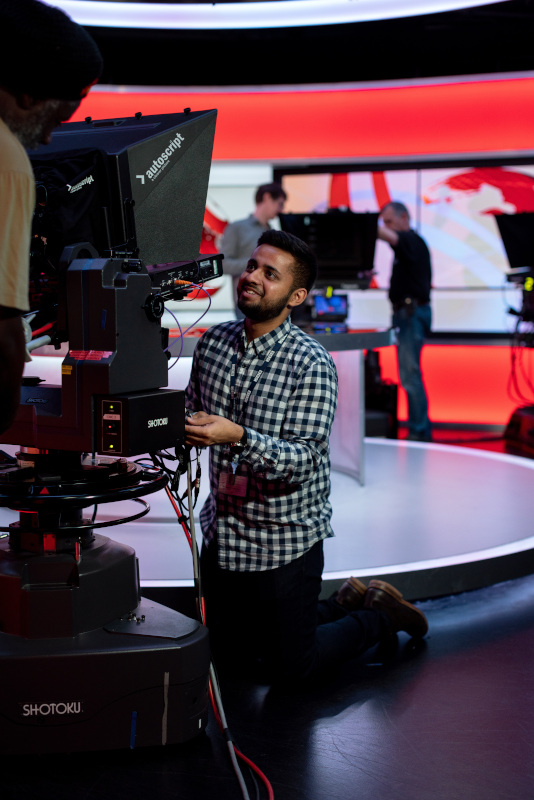
The TV news format has basically remained the same in Switzerland. Every 10 years or so the studio look and logo introduction design changes but that’s about it. There is still an anchorperson (now both women and men), desk, paper with notes in case the teleprompter breaks, intermittent reports from around the world.
Because of the Coronavirus I wanted more information about what was happening in the States. I felt the news we got in Switzerland about the States, was only the tip of the iceberg. So Ben and I started watching English speaking news, too. We tuned into CNN (Cable News Network) a US-American news network based in Atlanta. I have also watched Fox News (an American conservative cable television news channel, owned by the Fox News Group) based in New York. To say I was surprised at what I saw might be an understatement.
Bias News
I basically thought that all news was unbiased. Wrong. Of course I knew that China, for example, has country operated news. You only hear what the government wants you to know. But that is China.

What I have found out is in the States, which news station you watch depends on which political party you support. Fox News, as I mentioned above, is conservative. That means they are very pro-republican. They tend to ‘slant’ the news in favor of the conservatives. Once, when I wrote someone who I had never talked politics with, I mentioned which news I was watching. She wrote back and said she avoided talking politics with friends (which is fine with me). In the same sentence she said she watches Fox News 24/7. Aha.
Naturally that doesn’t mean that all the other news stations are unbiased. Not even the ones in Europe are immune to that, although I have a feeling that they are better than elsewhere. Europe is very pro-democrat. Think about it, they were all praise for Obama and highlight every blunder Trump makes. But I don’t want to make this post political.
Opinion
The reason I started watching the other news stations is because I wanted to get a feel of what was happening in the States. What was important there. What better way than to watch their news. What I noticed was, as in Switzerland, all the other stations slip into opinion after running out of facts.

After all, just presenting the facts would make the news extremely short. What do you do with the other 29 minutes in a half hour program? Of course, you can ask what the journalist thinks. Usually they start with ‘I can’t really say, BUT…’ then launch into a long opinion of what the future might bring. Quite often their opinion is presented as fact. The viewer naturally assumes that the journalist has some inside information to support their opinion. Sometimes I think it would be better if they would just start their answer with something like ‘I don’t know, my guess is as good as yours. BUT let me look into my crystal ball…’
Emotion
Another difference that I noticed between the American news compared to the Swiss news is the emotion involved, or lack thereof. The Swiss news is very dry. There have been times when they have come close to emotional, but never too close. It must be an unwritten policy somewhere.
The American news is full of emotion as is the news in the United Kingdom. I was surprised by how the UK presented the Coronavirus news. They strive to make it up close and personal. What better way to make the death statistics come alive than give names, ages, faces and a short biography to the numbers. I was taken aback when I saw that. But they made their point loud and clear; we are dealing with people and not statistics. Don’t forget that. These are people like you and me. Still, there is no way Swiss TV would do something like that. The data protection agency would jump on them without mercy.
Visual Format
Another difference between American and Swiss news is the visual format. Okay, granted, the American format is for 24 hour news. Nobody watches news 24/7 so you have to find ways to present all that information efficiently.
But as I stated in the beginning, the Swiss news was and still is presented 3 times a day in a formal manner with an anchor behind a desk. Occasionally they will have a live interview where you see the anchorperson interviewing a journalist. The screen is position so it looks like the two are talking directly to each other.
For me the ‘new’ American format took some getting used to. There’s a lot to take in. Firstly there is a banner scrolling across the bottom of the screen showing ‘top news’. Important data is on the right, which at the moment is the global and US Coronavirus statistics. Any ‘breaking news’ is also listed there. The rest of the screen shows either the face of the anchorperson alone or the space is shared with the person the anchor is interviewing. If the person interviewed has a lot to say they will be shown alone. Above the scrolling banner with the ‘top news’ the name of the person talking is shown, their job or position and important bits of what they say (in case you missed something). This information doesn’t scroll from side to side but top to bottom.
If you ask me, it’s a chaotic mess. Focusing your attention on listening to the person talking and reading at the same time isn’t easy! I’ve found myself missing things someone said because I was trying to read the scrollbar. Multitasking isn’t for everyone.
Interviewing
Sometimes the interview will involve more than one person at a time. Then the main part of the screen is divided up even more. One of the more interesting interviews I saw had three people: the anchor in the middle, someone from California on the left and another person from New York on the right. The interview started out normal; the anchor asked a question and ‘California’ answered. The anchor then asked ‘New York’ a question. During that answer, ‘California’ asked ‘New York’ a question and then more questions and aggressively took over the interview. That’s when sparks started flying. Don’t get me wrong, everyone stayed polite but there were some extremely subtle and not so subtle undertones. I don’t know if ‘California’ had a personal vendetta against the anchor but that was one weird interview.
Visual
Then there’s how the person actually looks on the screen. With all the stay at home orders at the moment in the States most people do interviews from their homes, via computer. Which, of course, is good. Generally the reporters and professional TV presenters look and sound good. But the doctors and specialists whose daily business isn’t Skyping or Zooming have a lot to learn. Can’t they see that the camera angle is so wrong? Quite often it looks like the camera is sitting on their laps putting everything, including the background, into a frog perspective. The view of the person’s head is distorted not to mention the super view of their nostrils.
Of course you might counter with the argument that content is more important than visual presentation. Of course it is. Still, TV is a visual media. Use it to its full extent.
Wrapping it Up
What is also interesting is how the American anchor adds their personal, emotional touch. Quite often you will hear an ‘Oh, that’s awful.’ or something similar when interviewing someone before asking another question.
But what shines above everything else is how polite and nice the American anchors are. Sure, the Swiss aren’t abrupt and they say thank you, too. But somehow the Americans go the extra mile. There is always a ‘Thank you for taking the time for this interview’ and often included is a ‘Sir’. They also wish the person they are talking to good health and safety. And quite honestly, they sound like they mean it.
So, for those of you I know personally I would like to thank you for your interest in Cowbells and Chocolate. It means a lot to me that you drop by and read and hopefully enjoy what I write. I wish you all good health and please stay safe. For those of you I haven’t had the good fortune to meet yet, I wish you exactly the same: good health, stay safe and thank you. I appreciate your interest.
 -
- -
-