
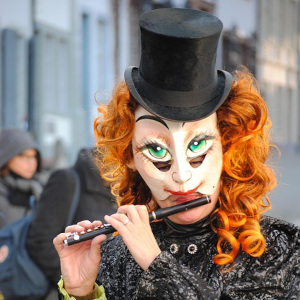
Well, of course we all know the four seasons, there’s Spring, Summer, Fall and Winter but when is the fifth season? I suppose the better question would be what is a fifth season? When an event takes place that effects the rhythm of life much in the way the four seasons do, it is said to be the fifth season. Officially the fifth season can last from a few days to weeks. Exactly when this happens varies by region and event. Believe it or not, there can be more than one fifth season in a year! Quite often it’s a carnival that triggers the fifth season as is the case in Büren an der Aare. There, the fifth season begins on January 1st and lasts two days.
What is a Carnival
Sure, everyone has heard of the carnival in Rio de Janeiro or the Mardi Gras [‘Fat Tuesday’] in New Orleans or other southern, onetime French colonial cities. Those are big deals often depicted in films. Lots of costumes, masks, noise and dancing. But what’s really behind a carnival?
Looking at the word a little closer you can see the words ‘carne’ and ‘vale’. ‘Carnival’, ‘carnevale’ or even the earlier version of the word ‘carnelevare’ translate directly from Latin into ‘meat’ and ‘to remove’. This signifies the approaching fast season (Lent) and therefore is Christian oriented. The idea was to eat all the food that would spoil during the fasting season. And all this eating created a festive feeling, so they went with the flow and made a festival out of it.
Carnivals in Switzerland
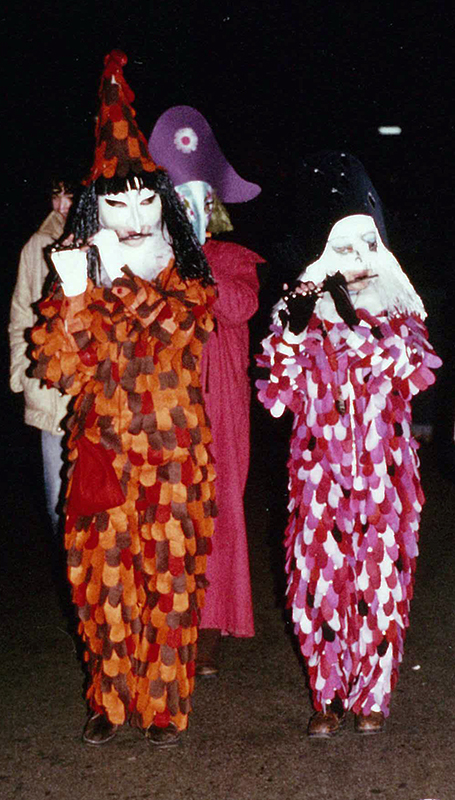
The Swiss word for carnival is ‘Fasnacht’. The word contains the two words ‘Fas’ [to fast] and ‘Nacht’ [night] which certainly ties to the Christian origins.
Both large and small carnivals enjoy a long tradition in Switzerland and originally took place in Catholic cantons but not always (a Swiss canton is similar to an American state). Basel, where the largest ‘Fasnacht’ is celebrated, is a Protestant canton. It was Catholic before the Reformation and therefore had a ‘Fasnacht’ or carnival. After the Reformation they continued the carnival tradition and have so until this day. At some point they changed the date of the carnival to after Ash Wednesday so it wasn’t quite so aligned with the beginning of Lent.
Although each Swiss carnival is individual, there are similarities. The people, including school classes are in costumes with or without masks. There is a parade with or without floats where candy is thrown out to the children watching. Quite often the instrument of choice during the parades are piccolo and drums as in Basel, but not always. Büren an der Aare has full blown bands marching down the street. So you can see, it’s not important how the music is made, but that it is made.
Then there is often a ‘Schnitzelbänk’. A ‘Schnitzel’ is a small, cut or torn piece of a whole, a scrap. There is a tool called a ‘Schnitzelbänk’ which is called a shaving horse in English. It is used to shave or cut down green or seasoned wood. In the same sense of cutting something down to be smaller and smoother, a ‘Schnitzelbänk’ is also a short rhyming verse. During the ‘Fasnacht’ a ‘Schnitzelbänk’ is presented as a clever, sung rhyme that incorporates an important event in the past year.
And of course there’s lots of food and drinks and confetti, confetti and more confetti at every Swiss carnival.
Büren an der Aare
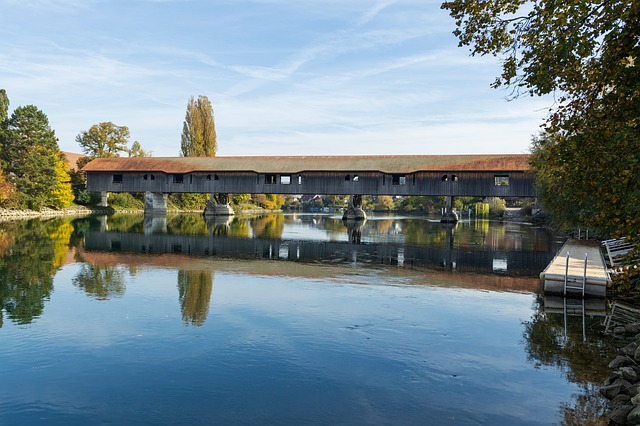
Büren an der Aare is a quaint town very close to where we live. The name of the town translates to ‘Settlement on the Aare’. The Aare is the name of a river in Switzerland. Good. Now that we’ve got that cleared, here’s the story of the ‘Fasnacht’ in a small town (around 3,800 people) with a long name, Büren an der Aare.
The carnival, as it presents itself now, originated from a combination of religion and economics and has a twist of legend in it. I’ll start with the religious aspect.
Religion
Many years ago, in 1470 a new chapel, which included a resurrection shrine, replaced an older, smaller one. The older one was mentioned in some writing in 1302 so obviously it was getting on a bit in years and was probably high time for a makeover. A new chapel was also necessary to accompany the rather large number of people journeying to Büren an der Aare. It seems that miracles had happened at the old chapel which made the town a place of pilgrimage. The miracle that made people flock to the chapel was the ability to bring stillborn children back to life long enough to be baptized. This baptism was necessary for the salvation of the child’s soul. Also according to the beliefs of the time, the souls of unbaptized infants went into limbo (limbus pueroum), one of the four underworlds and thusly brought great misfortune to their family and relatives.
The miracle of bringing babies back to life was achieved by warming the little body. A feather was then put in front of the child’s mouth and if it moved it proved the infant was alive and breathing. As long as the baby was alive it could be baptized. More than 2,000 babies were baptized in this manner.
The Reformers looked upon this as a superstition and an indulgence trade and, as a result of the 1529 Reformation, banned it. Obviously just banning something doesn’t stop it from happening. The pilgrimage continued so further steps were taken to stop it. In 1534 the ‘new’ shrine was demolished and any further pilgrimage was suppressed by force.
In 1992 – 97 excavations of the chapel area revealed a large complex with an elevated church and a chaplain’s house. Unfortunately many, if not all the children that had been brought back to life to be baptized, didn’t continue to live. The excavations also uncovered around 250 child skeletons.
With that bit of history in mind we get to the economic side of the story.
Economy
I do not profess to being knowledgeable in economics but I know it has to do with trade, consumption and money. Obviously a steady stream of people trekking to Büren an der Aare brought in a steady flow of cash. After all, these pilgrims had to eat, sleep and most probably had to pay for their baptismal services. Pilgrimage was a lucrative business. In 1534, as I already mentioned, the pilgrimage was stopped and with that a sure source of money was cut off for good. Büren an der Aare was not looking at a rosy economic future.
It is said that the Bernese government heard the cries from Büren an der Aare. As a type of compensation for their economic losses from the pilgrimage, the government offered the little town on the Aare river a special carnival. What Bern offered was the permission to hold a carnival on January 1st and 2nd. I suppose the idea being that the number of people who congregated to the first carnival of the year would more than make up for any income lost by the lack of a pilgrimage. I have no idea if the calculation worked or not, but it was probably all the town was going to get so of course they took the chance.
The Carnival
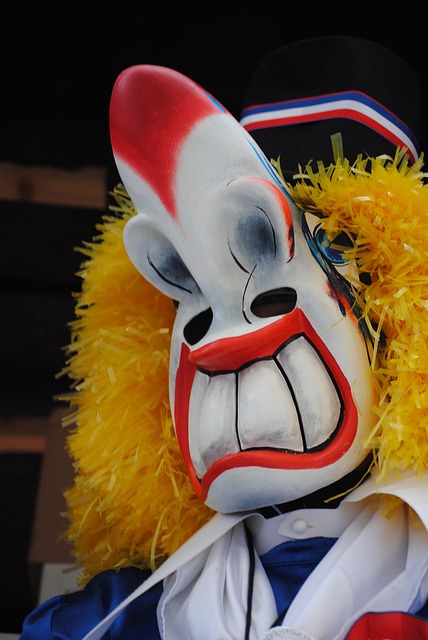
So, every year on January 1st and 2nd it’s time to party in Büren an der Aare. They ring in the New Year by putting on costumes with masks that reflect that year’s chosen theme. Different groups of people wearing matching costumes, some with and some without floats, walk and dance in organized parades making music and noise.
Everyone is involved, even the town gets into the masquerade fever by changing its name for two days. All the signs with the town name on them are changed to ‘Türmliwil’ [small tower village].
The Legend
Then on the 2nd, in the marketplace, they burn a figure called ‘Nimmerselig’ [Never Blessed]. A little research brought to light exactly who this ‘Never Blessed’ is supposed to represent. In 1386 the town of Büren was burned down almost completely. It was thought to be arson. After a long search the alleged arsonist was captured and sentenced to be ‘never blessed’ and to death by fire, which took place on the evening of January 1st. This person was mentioned by Conrad Justinger in 1450, in the Berne Chronicles. Many years after the event. The facts here, if any, may be a bit blurred. Some even believe that the chronics themselves are a forgery. Despite this controversy, at some point in the 18th century the legendary ‘Never Blessed’ appeared at the New Year’s carnival. The search, capture and burning of ‘Nimmerselig’ is symbolically recreated.
The Swiss seem to have always enjoyed and even identify with ‘their’ ‘Fasnacht’, even today. So much so that it’s called the fifth season. It’s an event where many, many people line the streets shoulder to shoulder to watch the parade. And, although thanks to refrigeration, food doesn’t spoil as fast as it did in the Middle Ages, huge amounts of bratwurst, beer and anything else the vendors are selling are consumed. In general, it’s a time that changes your rhythm and to be enjoyed immensely. And, lucky us, the very first carnival of the year is only a stone’s throw away from where we live.
Unfortunately, due to circumstances out of everyone’s control, the 2022 carnival was cancelled due to COVID. I suppose that only leaves us to enjoy the fifth season in our hearts this year and anticipate next year’s ‘Fasnacht’ even more.
Here’s a rather long YouTube video of the 2014 Büren an der Aare carnival. It shows both the parade and the burning of ‘Nimmerselig’.
Pictures from Pixabay.com
 -
- -
-